
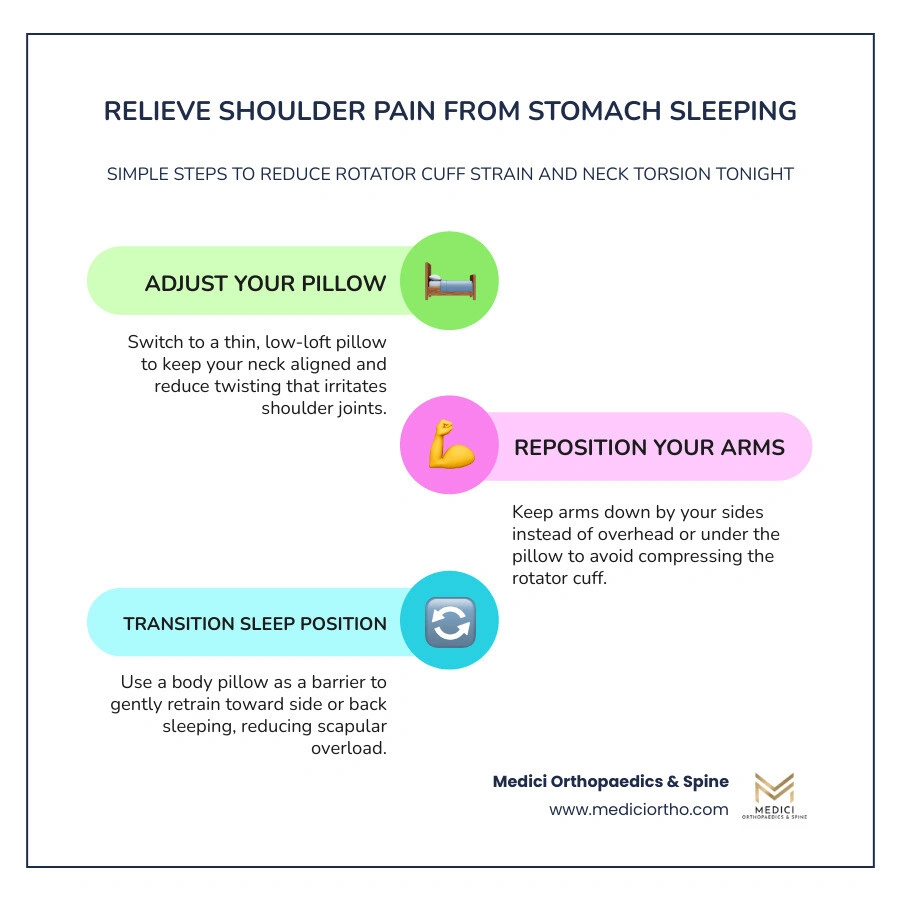
Sleeping on your stomach can cause shoulder pain because it forces your neck to stay turned and often leaves one or both arms raised, tucked under a pillow, or pinned beneath your body. To reduce the strain tonight, try these steps:
This position can irritate the rotator cuff, narrow the space around the shoulder tendons, and overload muscles between the shoulder blades. It may also trigger neck stiffness, tingling, or an ache that travels into the shoulder or arm. If pain lasts through the day, causes weakness or numbness, wakes you repeatedly, or does not improve after a few weeks of sleep changes, seek medical care.
I am Sonny Dosanjh, M.D., a board-certified Physical Medicine and Rehabilitation physician and fellowship-trained pain specialist who evaluates shoulder, spine, and nerve pain. In my work with active adults, I help identify whether sleeping on stomach shoulder pain is mainly a positioning problem, an irritated tendon or joint, or a sign of a condition that needs targeted treatment.
Sleeping on stomach shoulder pain terms to learn:
When we evaluate patients across our Metro Atlanta clinics, prone (stomach) sleeping consistently ranks as the most mechanically demanding sleep posture for the human frame. The Mayo Clinic describes prone sleeping as the most mechanically stressful common sleep position for the neck and upper back.
Adults spend roughly one-third of their lives in bed, subjecting joints to prolonged static loads for 7 to 8 hours each night. When you lie face down, you cannot breathe through your mattress. To maintain an open airway, your cervical spine must stay rotated 60 to 90 degrees to one side for hours. This creates sustained asymmetric torque that cascades into your shoulder girdle.
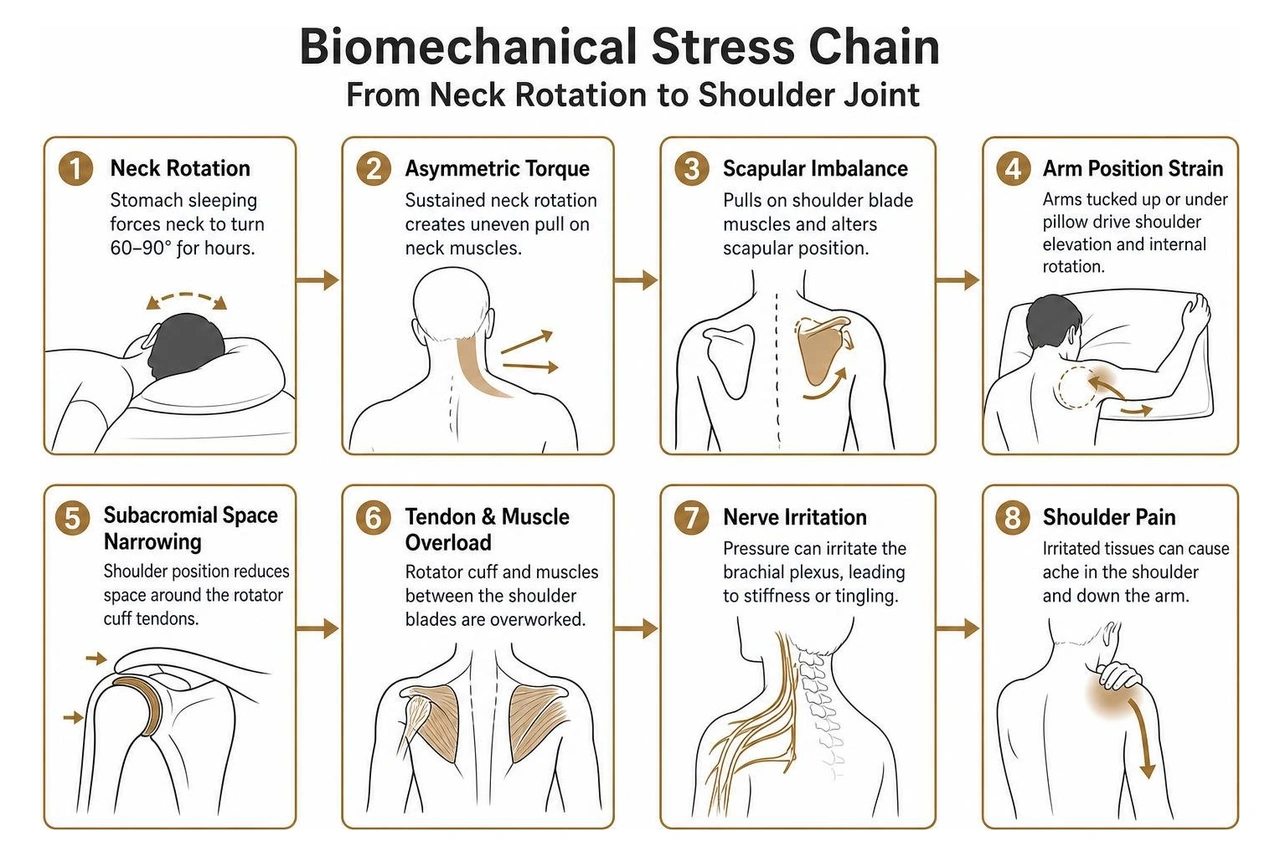
This rotational strain pulls on stabilizing musculature, alters scapular resting positions, and directly compromises the subacromial space within the glenohumeral joint. Clinical findings regarding inter-scapular sleep load show that chronic prone postures continuously overwork scapular retractors while pinching anterior structures.
Stomach sleepers frequently tuck one or both arms upward under their pillow—creating what clinicians call the "W" or "overhead" arm posture. This combines extreme glenohumeral elevation with internal rotation, placing ischemic pressure on the rotator cuff tendons and compressing the delicate nerves of the brachial plexus. Following practical tips on avoiding morning strain is essential to decompress these tissues before micro-trauma turns into chronic inflammation.
The rotator cuff consists of four stabilizing muscles: the supraspinatus, infraspinatus, teres minor, and subscapularis. Among these, the supraspinatus tendon is especially vulnerable. It passes through the narrow subacromial space beneath the bony acromion shelf of your shoulder blade.
When you sleep on your stomach with your arm abducted and overhead, the head of the humerus glides superiorly and pinches the supraspinatus tendon and subacromial bursa against the acromion. This position is a primary driver of shoulder impingement syndrome.
Rotator cuff tendons naturally have limited vascularity, a hypovascular "critical zone." Constant compression from your body weight cuts off localized capillary blood flow (ischemia). Adults over forty are especially susceptible to this damage because the supraspinatus tendon undergoes natural age-related degeneration, losing tensile elasticity. When starved of blood flow for several hours, these tendons become inflamed, resulting in sharp anterior shoulder aches and morning joint stiffness.
Your shoulders do not function in isolation; they are anchored to your spine through muscular slings. Sustained 60- to 90-degree cervical rotation places heavy mechanical loads on the ipsilateral rhomboids (major and minor) and the contralateral levator scapulae and upper trapezius.
As your neck twists, your thoracic spine flattens and twists out of its natural kyphotic curve. This asymmetric torque transfers downward into the mid-back and lumbar segments. This biomechanical chain explains how postural strain can cause sharp nerve pain in the back and spine.
The rhomboid muscles must contract isometrically throughout the night to stabilize the twisted scapula against the rib cage. By morning, these muscles suffer from metabolic fatigue and localized lactic acid accumulation. This generates a deep, burning ache between the shoulder blades that radiates into the posterior shoulder and down the lateral arm, mimicking a primary joint injury.
If you cannot break the stomach sleeping habit overnight, modifying your sleep surface and pillow configuration is the best first step. Proper ergonomics can reduce mechanical torque on your cervical spine and decompress the shoulder joints.

A clinical trial published in the Journal of Pain Research demonstrated that targeted pillow intervention alone reduced neck and shoulder pain scores by 40% in adults over eight weeks—without altering their mattress. Most sleep-related inter-scapular and shoulder pain resolves within 2 to 4 weeks after correcting mattress support, pillow height, and sleep posture.
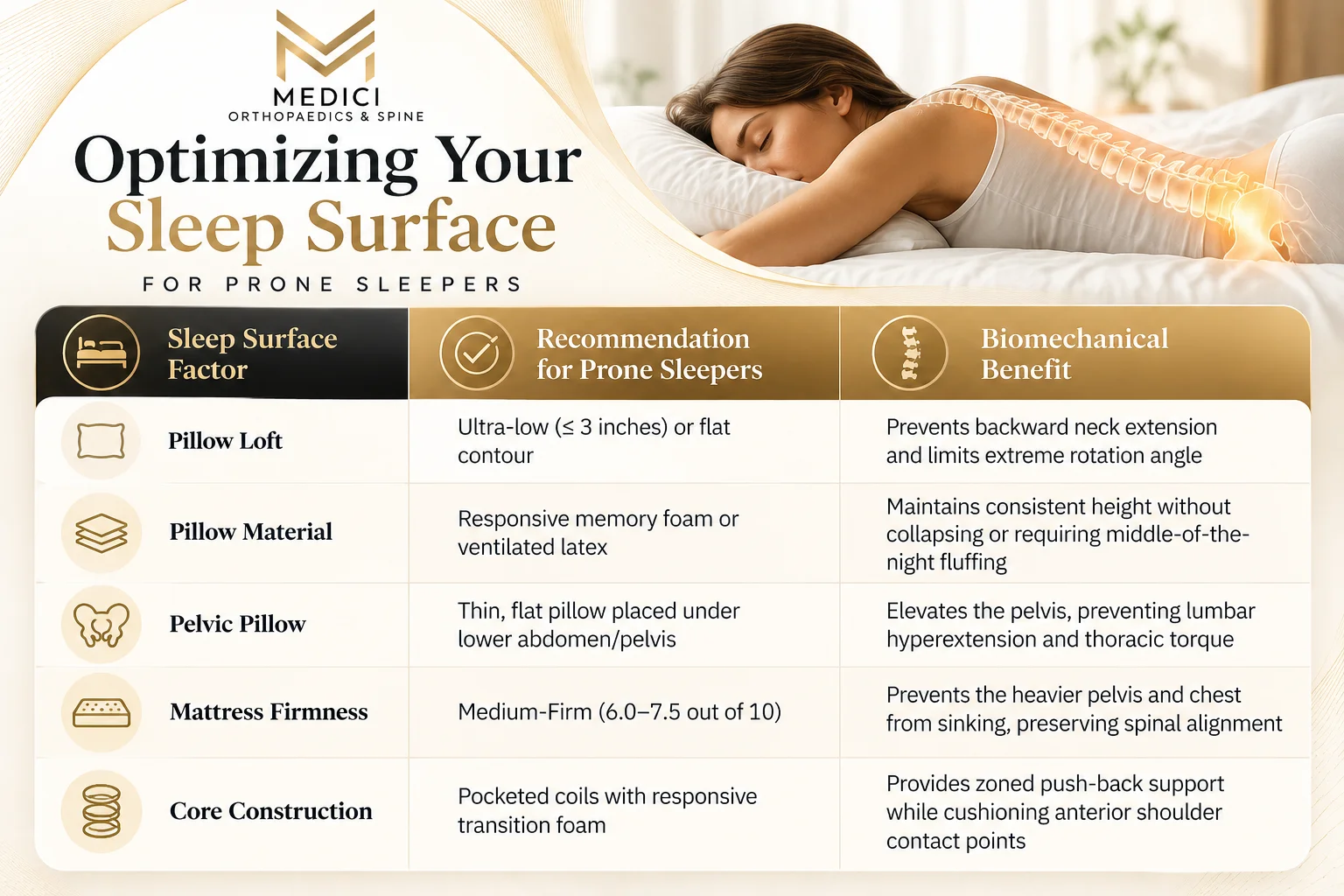
The primary mistake stomach sleepers make is using standard- or high-loft pillows (4 to 6 inches thick). A thick pillow props your head up into backward cervical hyperextension while your neck remains twisted. This crunches the posterior facet joints and compresses cervical nerve roots.
Stomach sleepers should use an ultra-low-loft pillow (3 inches or thinner) filled with responsive memory foam or natural latex. Latex maintains its dimensional shape through the night, unlike traditional down pillows that flatten out unevenly.
Place a second thin pillow directly beneath your lower abdomen and pelvis. Elevating the pelvis balances the lumbar lordosis, prevents excessive spinal extension, and unloads the compensatory tension placed on your upper back and shoulder girdle.
Mattress firmness plays a critical role in nocturnal shoulder health. When a mattress is too soft (under 5/10), your heavy pelvic core and chest sink deeply into the foam, forcing your spine into an exaggerated hammock shape. This increases rotational torque on the neck and forces the shoulder joint into awkward angles.
A medium-firm mattress (6.0 to 7.5 on the firmness scale) provides the push-back support needed to keep your body horizontal. For side and stomach sleepers struggling with surface pressure, investing in a shoulder pain mattress topper made of high-density memory foam or latex can offer 2 to 3 inches of targeted pressure distribution. This cushions anterior joint contact points without allowing your spine to sag.
Transitioning away from stomach sleeping is the most definitive way to eliminate position-induced shoulder pain. However, sleep habits are deeply ingrained neuromuscular patterns. Trying to switch to your back without support often results in insomnia or rolling back onto your stomach within an hour.

Research on sleep-related shoulder strain shows that transitioning to a supported side-lying or back-sleeping posture eliminates the static joint compression and torsion that cause morning symptoms. Exploring comprehensive shoulder pain sleep solutions will help you protect your joints as you rebuild your sleep habits.
The body pillow bumper technique prevents you from rolling flat onto your stomach while you sleep.
If you cannot sleep fully on your side, use a modified semi-prone posture (the "quarter-turn"). Lie three-quarters on your side, propping your chest and torso against an angled wedge or body pillow, with your bottom arm resting comfortably down by your side rather than under your head.
For patients managing bilateral shoulder discomfort, switching to supine (back) sleeping is ideal. Place a small, folded towel or thin pillow under each elbow and forearm. This slightly elevates your arms, opening the subacromial space and preventing gravity from pulling the humerus backward into an overstretched position.
When you wake with morning stiffness, avoid aggressive stretching. Pulling hard on an inflamed, ischemic tendon can cause micro-tearing. Instead, gentle active mobility and thermotherapy help restore local blood flow and ease muscle tightness.
Many patients worry that morning shoulder pain indicates a structural tear requiring surgery. However, adopting conservative care before surgery resolves the vast majority of sleep-related musculoskeletal issues without invasive procedures.
Perform these five gentle mobility exercises while your tissues are warm—ideally right after a hot morning shower:
While most sleep-related shoulder discomfort responds to sleep posture changes, certain symptoms warrant a comprehensive orthopedic evaluation. Left unaddressed, chronic subacromial inflammation can develop into adhesive capsulitis, commonly known as frozen shoulder.
Schedule an appointment with a specialist if you experience:
If you are dealing with unresolved pain, consulting a shoulder pain specialist in Marietta or at our Buckhead, Snellville, or Kennesaw offices will help you get an accurate diagnosis and a customized recovery plan.
Numbness, tingling, or the feeling that your arm has "fallen asleep" occurs because of nerve or vascular compression. When you sleep prone with your arm raised overhead or tucked under a pillow, the humeral head presses against the axillary neurovascular bundle and the brachial plexus.
This posture also narrows the thoracic outlet—the space between your collarbone and first rib. This restricts blood flow through the axillary artery while compressing the nerves traveling down your arm, causing temporary paresthesia. Adjusting your arm position releases this compression and restores normal circulation.
The fastest way to adapt to back sleeping is to use a supportive wedge pillow or elevate your knees with a bolster. Placing a firm pillow beneath your knees tilts your pelvis backward and flattens your lumbar spine against the mattress, preventing lower back tension.
Position secondary pillows along both sides of your torso as bumpers to keep you from rolling over during deep sleep. Giving your body a few weeks to adjust to these physical boundaries makes the transition much smoother.
A mattress topper can provide meaningful relief if your shoulder pain stems from surface pressure against a mattress that is too firm. A 2- to 3-inch topper made of responsive memory foam or latex contours around your body, distributing pressure across your chest and shoulders.
However, if your pain is caused by the rotational torque of stomach sleeping, a topper alone will not fix the issue. You must combine surface cushioning with proper pillow loft and posture modifications to fully protect your spine and joints.
Shoulder pain from stomach sleeping is a clear sign that your joints and spine are under prolonged mechanical stress. Sustained neck rotation, subacromial impingement, and overstretched scapular muscles can turn your nightly rest into a source of morning pain.
At Medici Orthopaedics & Spine, we help active adults resolve joint and spine pain through effective, minimally invasive, and non-surgical approaches. Our multidisciplinary care model combines physical therapy, interventional spine and joint treatments, regenerative medicine, and postural retraining to restore your mobility.
If modifying your sleep setup does not fully relieve your shoulder or neck pain, we can help identify the root cause. Discover how our team approaches restoring sleep posture and spine health, or contact our clinics in Buckhead, Marietta, Kennesaw, or Snellville to schedule your evaluation.
At Medici, you’re more than your MRI.
We take time to hear your story, understand your pain, and create a plan that actually works for you.

Our team delivers specialist care at convenient locations across Metro Atlanta:
Get expert tips on injury recovery, pain relief, joint health, and movement strategies—straight from our Fellowship-Trained team.