Why Safe Lower Back Pain Stretching is Your First Step to Relief
If you are struggling with a stiff, aching spine, starting a safe routine of lower back pain stretching is the fastest way to calm muscle spasms and get moving again.
Your back has been barking for days. Maybe you bent over to pick up a laundry basket, felt a sudden "catch," and now standing up feels like a major chore. You are not alone. Over 25% of American adults are dealing with back pain right now. It is the leading cause of missed work days worldwide.
While your first instinct might be to lie down, strict bed rest actually makes your muscles tighter. Gentle movement is the real key to recovery.
Quick Guide: How to Safely Stretch for Lower Back Relief
- The Single Knee Hug: Lie on your back, pull one knee to your chest, and hold for 20 to 30 seconds.
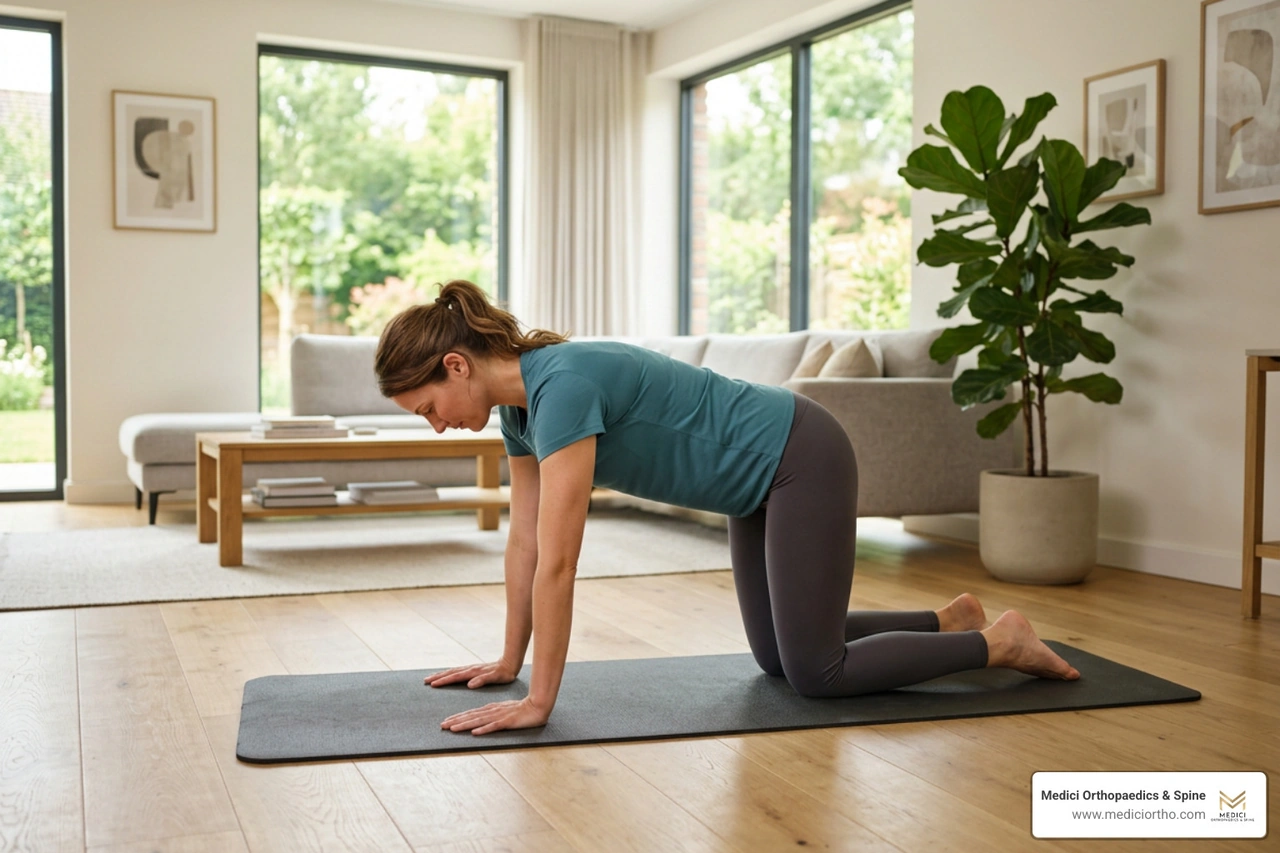
- The Cat-Cow: Get on all fours. Slowly arch your back up like an angry cat, then let your belly sag down. Repeat 5 to 10 times.
- The Seated Hamstring Stretch: Sit on the edge of a chair, extend one leg out, and lean forward at your hips. Keep your back straight.
- Keep Pain Low: Never push a stretch into sharp pain. Keep your discomfort at a 5 or lower on a scale of 10.
I am Sonny Dosanjh, M.D., a board-certified physical medicine and rehabilitation physician and the founder of Medici Orthopaedics & Spine. As a former athlete and spine specialist, I have spent my career helping active adults use lower back pain stretching and other non-surgical, drug-light therapies to reclaim their mobility.
Understanding the Causes of Lumbar Discomfort and When to Use Lower Back Pain Stretching
To understand why your back hurts, we have to look at how the human body is put together. Some physical therapists and evolutionary biologists jokingly refer to the lower back as a "design flaw in human anatomy." Because we walk upright, our lumbar spine carries a tremendous amount of physical pressure day in and day out.
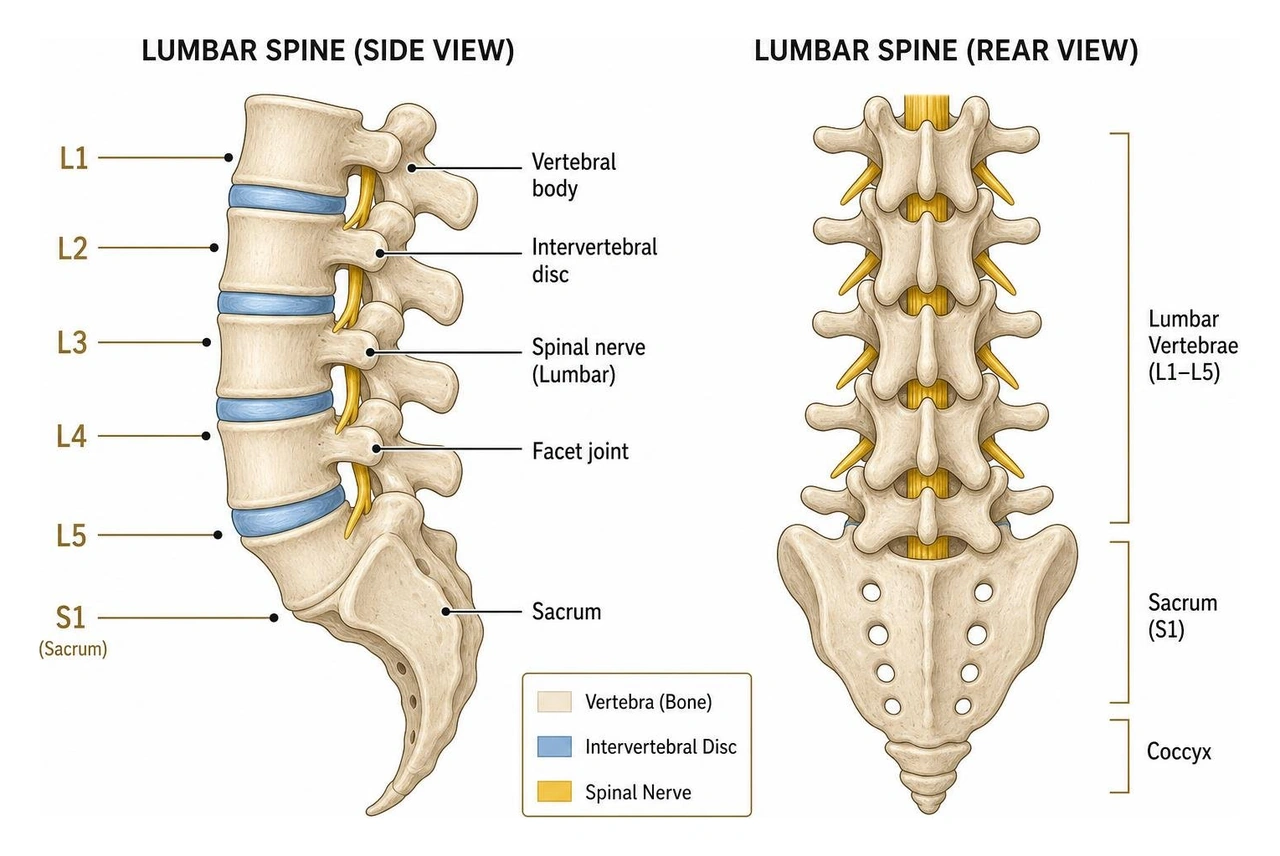
The lumbar spine consists of five large vertebrae (L1 through L5) stacked on top of one another, cushioned by jelly-like spinal discs. These bones are held together by a complex web of ligaments, tendons, and major muscle groups, including the paraspinals, the multifidus, and the quadratus lumborum.
When your back hurts, the issue generally falls into one of two categories: mechanical strain or nerve impingement.
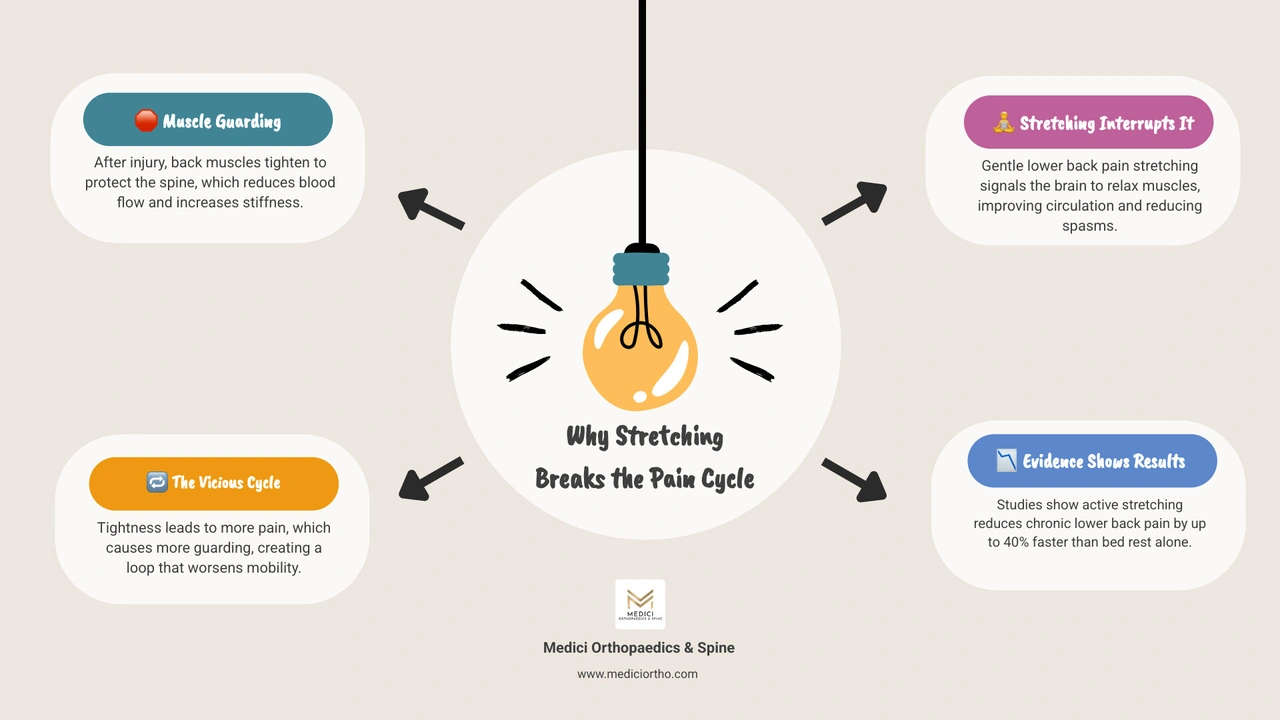
- Muscle and Tendon Strains: This is the most common cause of acute back pain. It happens when you twist awkwardly, lift something too heavy, or spend hours hunched over a desk. The muscles in your back immediately lock up to protect the spine. This is called "muscle guarding." While guarding is helpful for the first 48 hours to prevent further damage, keeping those muscles locked up long-term creates a painful cycle of stiffness.
- Nerve Impingement: This occurs when a structural issue pinches the nerves leaving your spinal cord. Common culprits include herniated or bulging discs, spinal stenosis (narrowing of the spinal canal), and spondylolisthesis (where one vertebra slips forward over another). Spondylolisthesis often starts as a small stress fracture in the pars interarticularis (spondylolysis) during youth and progresses later in life.
- Sciatica: A specific type of nerve impingement where the sciatic nerve—the largest nerve in the body—becomes compressed. This causes sharp, shooting pain, numbness, or tingling that travels from your lower back, through your glutes, and all the way down your leg. Interestingly, sciatica can sometimes cause pain strictly in your calf or foot, with no pain felt in the back at all!
Unilateral vs. Bilateral Pain
Is your pain on just one side (unilateral) or both sides (bilateral)? Because the anatomy of your back is perfectly symmetrical, most mechanical strains and herniated discs affect only one side at a time. It is rare to injure the muscles on both sides of your spine simultaneously.
However, if you have bilateral pain, it could point to a more central spinal issue like stenosis, or even systemic conditions. In incredibly rare cases, deep left-sided back pain can be linked to the aorta, which runs down the left side of the spine. If you ever experience sudden, tearing pain, seek emergency medical care immediately.
Why Rest is the Enemy
When your back is in pain, your brain tells you to lie down on the couch and not move. However, clinical studies show that complete bed rest is one of the worst things you can do. Inactivity causes your core and back muscles to weaken and tighten, which actually increases spinal compression.
To learn more about why staying active is superior to bed rest, read our detailed guide on Why Resting Your Lower Back Might Be Making Things Worse.
So, when should you start stretching? If your pain is a dull, mechanical ache, or if you are recovering from a minor twist or strain, gentle mobility exercises are highly recommended. According to clinical research, patients who practice a consistent stretching routine for just four weeks see an average pain improvement of 58%.
For a complete look at physical therapist-approved routines, explore the 9 Best Lower Back Stretches and Exercises to find out which movements are safest for your specific condition.
When your back is actively flaring up, you want to start with floor-based stretches. Floor stretches are highly effective because the ground supports your body weight, taking the pressure off your spinal discs and allowing your muscles to relax.
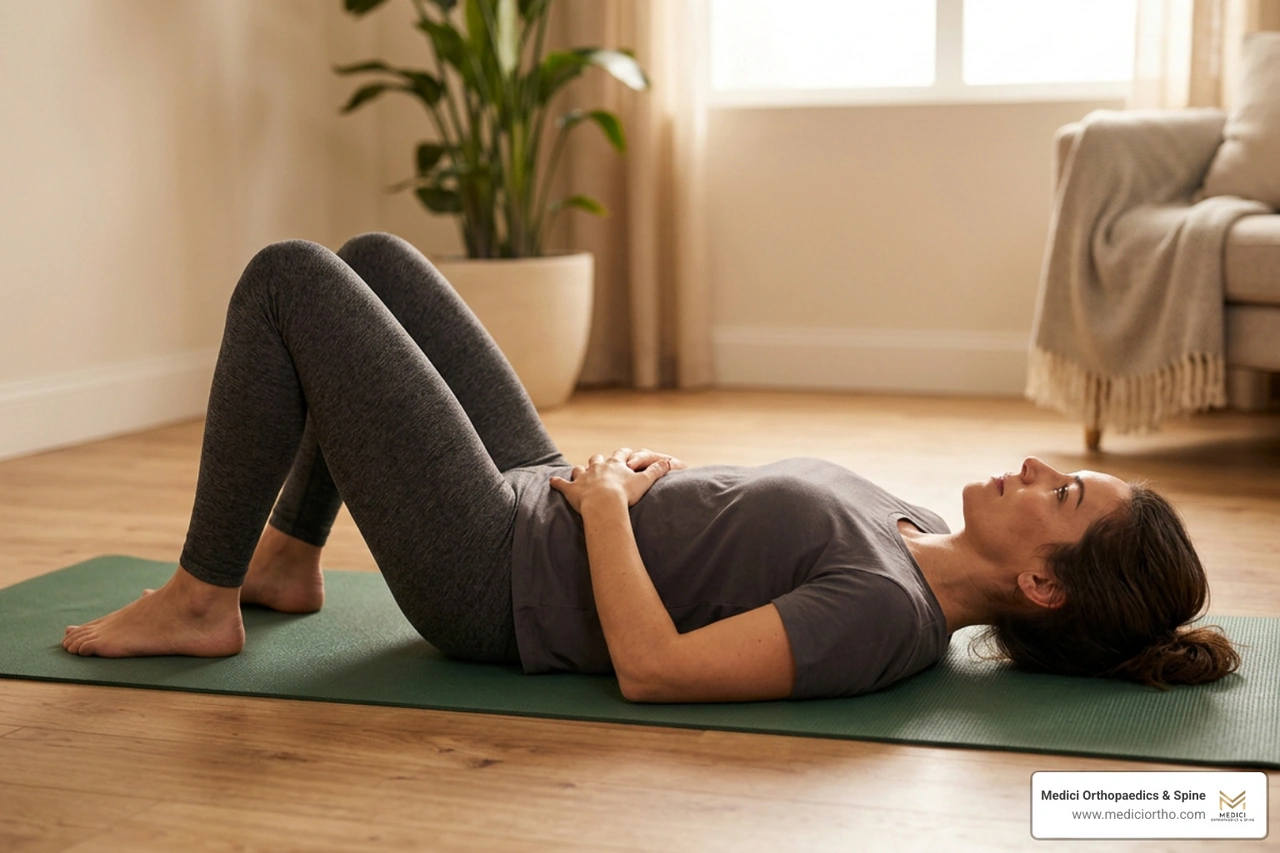
Here are the best floor exercises to calm an angry back:
1. Pelvic Tilts
The pelvic tilt is a micro-movement that gently mobilizes the lumbar spine and activates the deep abdominal muscles. It is the perfect way to warm up your back before moving on to deeper stretches.
- How to do it: Lie on your back with your knees bent and your feet flat on the floor, about hip-width apart.
- The movement: Inhale deeply. As you exhale, gently tighten your abdominal muscles and tilt your pelvis upward, flattening your lower back completely against the floor. Imagine trying to close the small gap between your lower back and the carpet.
- Hold and repeat: Hold this flat position for 5 to 10 seconds while breathing normally, then relax. Repeat 10 to 15 times.
2. The Single Knee Hug
This stretch targets the glutes and the lower paraspinal muscles on one side of your body at a time, making it highly customizable if you have unilateral pain.
- How to do it: Lie flat on your back with both legs extended.
- The movement: Slowly bring your right knee up toward your chest. Clasp your hands around your shin or behind your thigh. Gently pull the knee closer to your chest until you feel a mild stretch in your lower back and hip.
- Hold and repeat: Hold for 20 to 30 seconds. Slowly release the leg back down and repeat on the left side. Perform 3 rounds per side.
3. The Double Knee Hug
If you want to stretch both sides of your lower back simultaneously, the double knee hug provides a deeper release.
- How to do it: Lie on your back.
- The movement: Bring both knees up toward your chest at the same time. Wrap your arms around your shins. Gently hug your knees in, letting your lower back elongate.
- Hold and repeat: Hold for 20 to 30 seconds. To add a gentle massage to your lower back muscles, you can slowly rock side-to-side on the floor. Repeat 3 times.
4. Lying Trunk Rotation (Knee Rolls)
This movement improves rotational flexibility in the lumbar spine and stretches the obliques, which play a major role in supporting trunk rotation.
- How to do it: Lie on your back with your knees bent, feet flat on the floor, and arms spread out to the sides like a "T" to anchor your upper body.
- The movement: Keeping your shoulders pinned flat to the floor, slowly lower both knees to the right side as far as comfortable.
- Hold and repeat: Hold this position for 5 to 10 seconds. Use your core muscles to bring your knees back to the center, then slowly lower them to the left side. Repeat 5 times on each side.
To see how these floor stretches fit into a broader mobility routine for your entire lower body, check out our article on Simple Stretches to Support Hip, Knee, and Back Mobility.
Knee-to-Chest and Child’s Pose: Essential Lower Back Pain Stretching Techniques
Two of the most reliable and widely recommended movements for spinal decompression are the knee-to-chest stretch and the child’s pose. These postures are designed to gently pull the vertebrae apart, relieving pressure on compressed discs and pinched nerves.
The Knee-to-Chest Stretch (Modified)
While the standard knee hug is great, adding a slight modification can help target the deep piriformis muscle, which often compresses the sciatic nerve. This is sometimes called the "knee cradle" or "reclined figure-four."
- How to do it: Lie on your back with your knees bent and feet flat.
- The movement: Cross your right ankle over your left knee. Reach your hands through the space between your legs and clasp them behind your left thigh. Gently pull your left thigh toward your chest.
- Why it works: This opens up the hip joint and stretches the glutes and piriformis, which directly relieves the referred tension pulling on your lower spine. Hold for 30 seconds, then switch sides.
Child’s Pose (Balasana)
This classic yoga posture is a favorite of physical therapists because it provides passive spinal elongation.
- How to do it: Kneel on the floor with your knees spread wide and your big toes touching. Sit your hips back onto your heels.
- The movement: Inhale, then as you exhale, fold your torso forward between your thighs. Extend your arms straight out in front of you on the floor, palms facing down. Let your forehead rest gently on the mat.
- Why it works: As you reach your fingertips forward and sink your hips back, you create traction along your entire spine, decompressing the lumbar region.
- Modification: If your back is highly sensitive on one side, walk both hands to the right side of the mat to stretch the left side of your lower back, hold for 30 seconds, then walk your hands to the left.
If you are dealing with shooting leg pain, incorporating these gentle techniques is a great starting point. For more tailored advice, read the Harvard Health guide on Sciatica: Gentle stretches to help relieve pain and improve mobility - Harvard Health.
Cat-Cow and Hamstring Releases: Advanced Lower Back Pain Stretching for Mobility
Once your acute muscle spasms have started to settle, you can introduce dynamic stretches to restore your full range of motion.
The Cat-Cow Stretch
This dynamic movement alternates between flexion (rounding) and extension (arching) of the spine.
- How to do it: Get on your hands and knees in a tabletop position. Ensure your hands are directly under your shoulders and your knees are directly under your hips.
- The Cow Pose (Inhale): Slowly drop your belly toward the floor, lift your chest and tailbone toward the ceiling, and look slightly upward. Draw your shoulder blades together. This mimics a cow grazing in a field.
- The Cat Pose (Exhale): Round your spine up toward the ceiling, tucking your tailbone and drawing your chin toward your chest. Imagine an angry cat arching its back.
- Why it works: This gentle movement circulates synovial fluid—the natural lubricant inside your spinal joints—which reduces friction and eases morning stiffness. Repeat this flow 5 to 10 times in sync with your breath.
To ensure you are performing this movement safely without straining your neck, read the Cleveland Clinic’s guide on Cat-Cow Stretch: How To Do It and Benefits.
Standing Hamstring Stretch and Neural Glides
Did you know that tight leg muscles are a primary driver of lower back pain? Your hamstrings attach directly to your pelvis. When they are tight, they pull your pelvis backward (posterior pelvic tilt), which flattens the natural curve of your lower back and forces your lumbar spine to carry extra weight every time you bend over.
To release this tension safely, we recommend the standing hamstring stretch and neural glides (nerve flossing).
- Standing Hamstring Stretch: Stand facing a sturdy chair or step. Place your right heel on the seat of the chair with your foot flexed toward you. Keep your hands on your hips. Keeping your back perfectly flat, hinge forward from your hips until you feel a gentle stretch along the back of your thigh. Avoid rounding your lower back, as this strains the spine. Hold for 30 seconds, then switch legs.
- Neural Glide (Nerve Flossing): If you have mild sciatica, static hamstring stretching can sometimes irritate the sciatic nerve. Instead, try "nerve flossing" to gently slide the nerve through its surrounding tissues. Sit tall in a chair. Extend your right leg straight out in front of you. As you extend the leg, tilt your head back and point your toes away from you. Then, bend your knee slightly, tuck your chin to your chest, and flex your toes toward your shin. This gentle "flossing" movement keeps the nerve mobile without overstretching it. Repeat 10 times.
Core-Strengthening Exercises and Lifestyle Modifications to Prevent Future Pain
While stretching is excellent for immediate relief, it is only half of the equation. If you only stretch without building strength, your back pain will keep coming back. A strong core acts as a natural, built-in back brace that stabilizes your spine and protects it from unexpected twists and heavy lifts.
| Stretching | Core-Strengthening |
|---|
| Purpose: Elongates tight muscle fibers and decompresses tight spinal joints. | Purpose: Stabilizes the pelvis and supports the lumbar spine under load. |
| When to do it: Daily, especially during acute flare-ups or morning stiffness. | When to do it: 2 to 3 times a week once acute pain has subsided. |
| Key benefit: Immediate relief from muscle spasms and guarding. | Key benefit: Long-term prevention of future injury and wear-and-tear. |
Here are the best physical therapist-approved core exercises to build a resilient lower back:
1. Abdominal Bracing
This is the foundation of all core exercises. It teaches you how to engage your deep core muscles—the transversus abdominis—before you lift, bend, or stand up.
- How to do it: Lie on your back with your knees bent.
- The movement: Tighten your stomach muscles as if you are preparing for someone to step on your belly, or imagine "crushing a soda can" in the center of your abdomen. Keep breathing normally; do not hold your breath.
- Functional use: Practice this bracing technique during everyday movements, such as when you stand up from a chair or lift a grocery bag. Hold for 10 seconds, repeat 10 times.
2. Glute Bridges
Strong glutes are essential for a healthy back. If your glutes are weak, your lower back muscles have to overwork to keep you upright.
- How to do it: Lie on your back with knees bent and feet flat on the floor.
- The movement: Engage your core and squeeze your glutes to raise your hips off the floor until your body forms a straight line from your knees to your shoulders. Lift your hips about 4 to 6 inches.
- Hold: Hold for 5 seconds (or 3 deep breaths), then slowly lower down. Repeat 10 to 15 times.
3. Bird Dogs
This exercise builds rotational stability and coordination between your shoulders, core, and hips without placing any pressure on your spine.
- How to do it: Get on your hands and knees.
- The movement: Slowly extend your right arm straight forward while simultaneously extending your left leg straight back. Keep your hips level and parallel to the floor.
- Hold: Hold for 5 seconds, return to tabletop position, and switch to the left arm and right leg. Repeat 10 times per side.
To learn more about how to safely progress these exercises, read our expert article on the Top 7 Exercises to Relieve Lower Back Pain — Backed by Experts.
Lifestyle Factors that Impact Spine Health
In addition to exercise, several daily habits can either protect your back or slowly damage it over time:
- Sitting Habits: Prolonged sitting is a major cause of chronic back stiffness. If you work a desk job in Metro Atlanta, make it a rule to stand up, walk around, and perform a quick standing stretch for 2 minutes every hour.
- Weight Management: Carrying extra weight, especially around your midsection, pulls your pelvis forward and places constant, uneven physical pressure on your lumbar discs.
- Smoking Cessation: Clinical research shows that smokers experience significantly higher rates of back pain than non-smokers. Nicotine constricts blood vessels, which reduces the flow of oxygen and vital nutrients to your spinal discs, causing them to degenerate much faster.
Frequently Asked Questions about Lower Back Pain
How often and for how long should I stretch my lower back?
For optimal results, we recommend stretching 1 to 3 times daily. A quick, structured 15-minute daily routine split between the morning and evening is highly effective. Morning stretches help clear out stiffness from lying in bed, while evening stretches relax your muscles and increase local blood flow before you go to sleep.
When performing static stretches (like the child's pose or hamstring stretch), aim to hold each position for 20 to 30 seconds. Holding a stretch past 60 seconds offers diminishing returns and can actually over-fatigue your muscles.
How can I modify stretches if I have limited mobility or acute pain?
If getting down on the floor is too difficult, you can easily modify these movements using a chair, counter, or desk:
- Seated Cat-Cow: Sit tall in an armless chair with your feet flat on the floor. Place your hands on your thighs. Inhale to arch your back, and exhale to round your spine.
- Counter-Supported Child's Pose: Stand facing a kitchen counter or desk. Place your hands flat on the surface and slowly walk your feet back, hinging at your hips and lowering your chest toward the floor until you feel your spine elongate.
- The 0-10 Pain Scale: Always rate your discomfort during exercise. Keep your pain within an acceptable 0 to 5 range. If a stretch pushes your pain past a 5, reduce your range of motion, slow down, or break your routine into "micro-sessions" (doing just 2 to 3 gentle repetitions every hour rather than full sets).
What are the key safety guidelines and warning signs to stop stretching?
While stretching is generally safe, you should listen to your body and stop immediately if you experience any of the following "red flag" symptoms:
- Sharp, stabbing pain during or immediately after a movement.
- Numbness, tingling, or weakness that travels down one or both legs.
- Progressive weakness, such as "foot drop" (difficulty lifting the front part of your foot when walking).
- Loss of bowel or bladder control (this is a medical emergency known as Cauda Equina Syndrome).
If your back pain is the result of a sudden trauma (like a car accident or a fall), do not attempt to self-stretch. Consult a physician immediately to rule out fractures or structural damage.
Conclusion: Partnering with Medici Orthopaedics & Spine for Lasting Relief
Starting a safe routine of lower back pain stretching is an excellent, highly effective first step to reclaiming your active lifestyle. However, if you have been stretching consistently for a few weeks and your pain is still lingering, it is time to seek professional care.
At Medici Orthopaedics & Spine, led by Dr. Sonny Dosanjh, M.D., we specialize in helping patients find long-term relief without relying on heavy medications or major surgery. We offer a comprehensive suite of advanced, non-surgical treatments that work synergistically to restore your quality of life, including:
- Specialized Physical Therapy: Tailored exercises to correct muscle imbalances and stabilize your lumbar spine.
- Myofascial Release & Sports Massage: Targeted therapies to break up deep muscle knots and scar tissue.
- Advanced Injections: Including epidural steroid, facet joint, and trigger point injections to calm severe inflammation.
- Regenerative Medicine: Modalities like Platelet-Rich Plasma (PRP) to support natural tissue healing.
- Spinal Cord Stimulation (SCS): A cutting-edge, minimally invasive option for chronic, stubborn nerve pain.
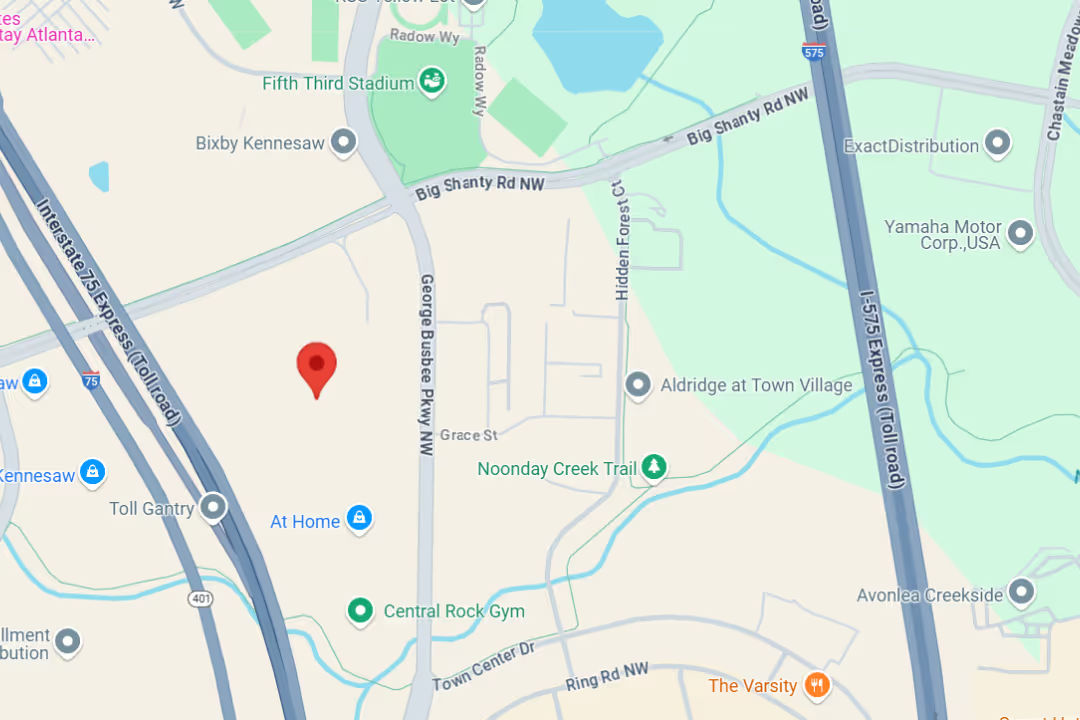
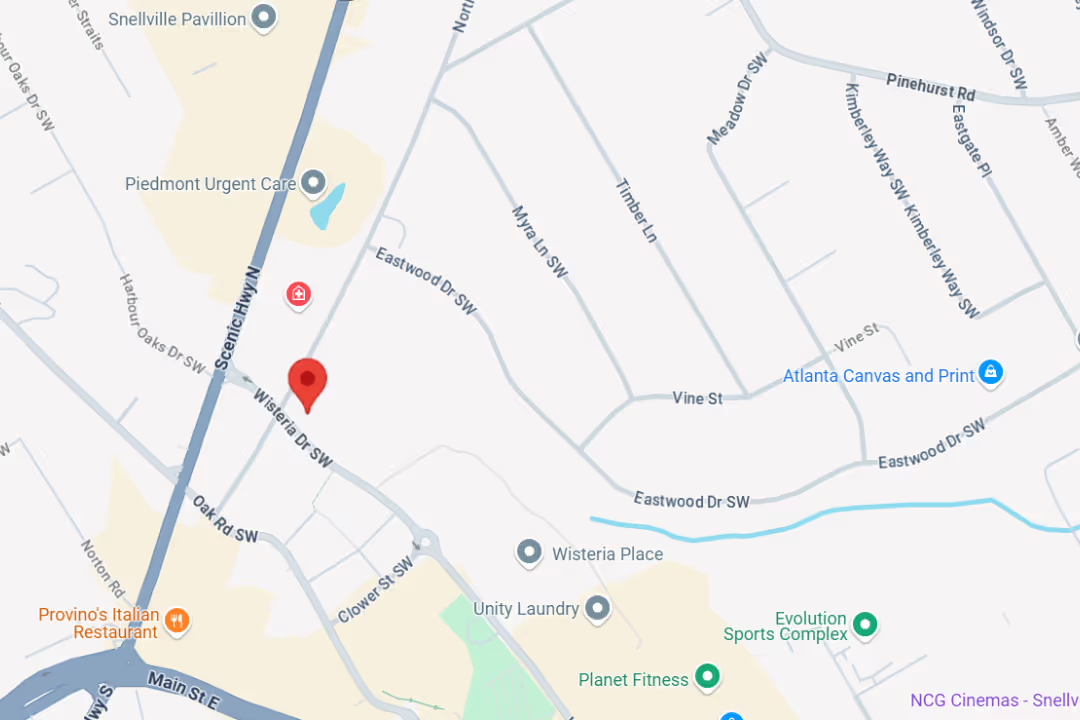
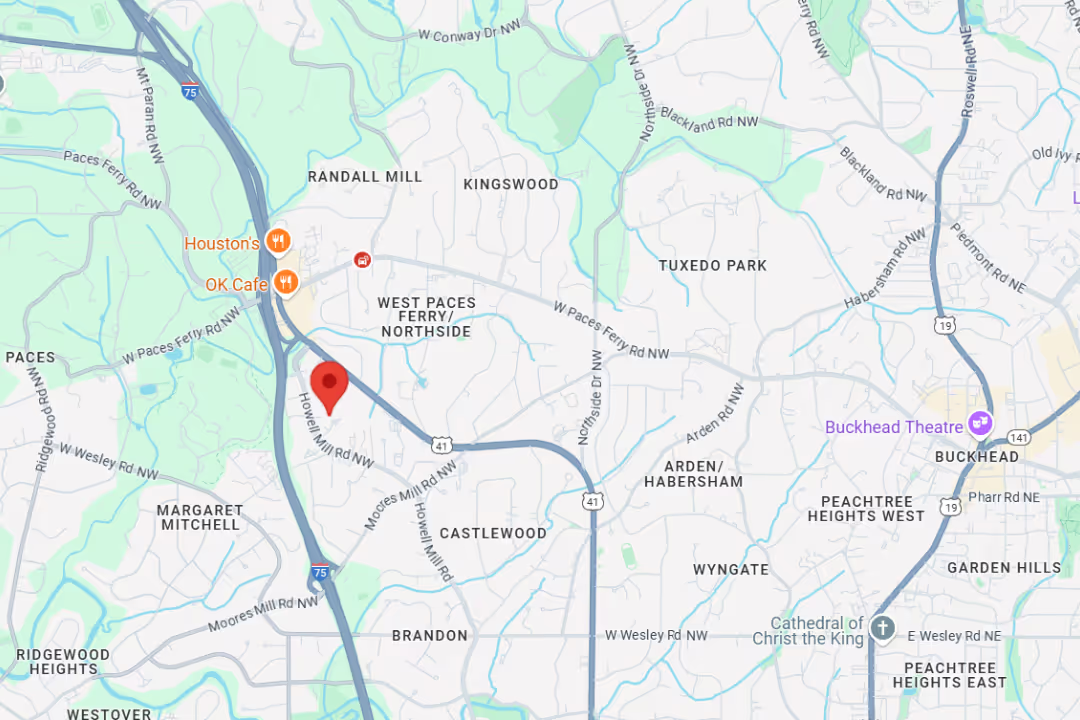
We proudly serve patients across Metro Atlanta with convenient locations in Snellville, Kennesaw, Buckhead, and Marietta.
Don't let back pain keep you on the sidelines. To explore your options and build a personalized recovery plan, read our comprehensive guide on The Best Non-Surgical Back Pain Treatments in Georgia: A 2026 Guide, or visit our Lower Back Pain Treatment page to request an appointment with our specialist team today. Let us help you optimally restore your quality of life so you can stop hurting and start moving!