Rotator cuff tear double row repair is a surgical approach that uses two rows of anchors — instead of one — to reattach a torn tendon to the bone, restoring more of the natural footprint and reducing the risk of retearing.
Quick answer: Yes, the technique matters — especially for larger tears.
| Repair Type | Footprint Restored | Retear Rate (Tears >3 cm) | Best For |
|---|---|---|---|
| Single-row | ~52.7% | Up to 62.5% | Small tears (<3 cm) |
| Double-row | Up to 100% | ~26–41.7% | Medium to large tears |
| Transosseous-equivalent (TOE) | Up to 100% | As low as 7.5% | Large to massive tears |
Every year, surgeons perform hundreds of thousands of rotator cuff repairs across the United States. For decades, the single-row technique — placing one line of anchors along the bone — was the standard. It works reasonably well for small tears. But as tear size grows, the gap between what a single-row repair can do and what the shoulder actually needs becomes significant.
The problem is straightforward: a tendon that isn't fully reattached to its natural footprint doesn't heal as well. And a repair that doesn't hold can lead to retears, persistent weakness, and the need for revision surgery.
Double-row and transosseous-equivalent (TOE) techniques were developed specifically to address these limitations — by compressing more tendon tissue against more bone, creating a stronger, more stable construct that gives the body a better foundation to heal.
But not every patient needs the most complex repair. And not every surgeon frames the choice the same way.
This guide breaks down the biomechanical evidence, the retear data by tear size, the tradeoffs between knotted and knotless techniques, and the factors that should drive the decision between single-row, double-row, and TOE repair.
I'm Sonny Dosanjh, M.D., board-certified in Physical Medicine & Rehabilitation and fellowship-trained at Emory University in Multidisciplinary Pain Management — and I've helped patients navigate the full spectrum of shoulder care, from conservative management to evaluating surgical options for rotator cuff tear double row repair and beyond. My goal is to make sure you understand every option clearly before any decision is made.
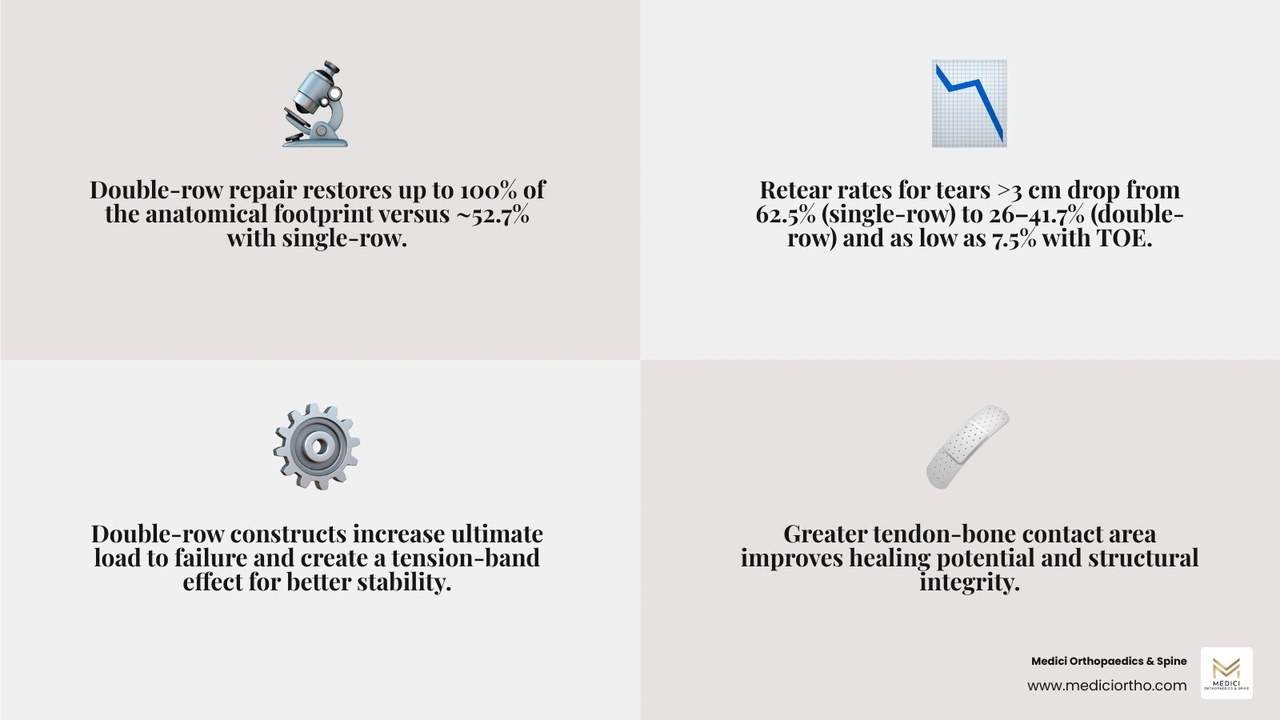
To understand why a rotator cuff tear double row repair is highly regarded by orthopedic surgeons, we must look at the mechanics of the shoulder joint. The rotator cuff is not a simple string that ties a muscle to a bone; it is a broad, flat, three-dimensional sheet of tissue that inserts into a wide anatomical footprint on the humerus (the upper arm bone).
When a tendon tears, it pulls away from this footprint. The goal of any repair is to re-establish a tight, stable connection between the tendon and the bone so they can knit back together during the healing process.
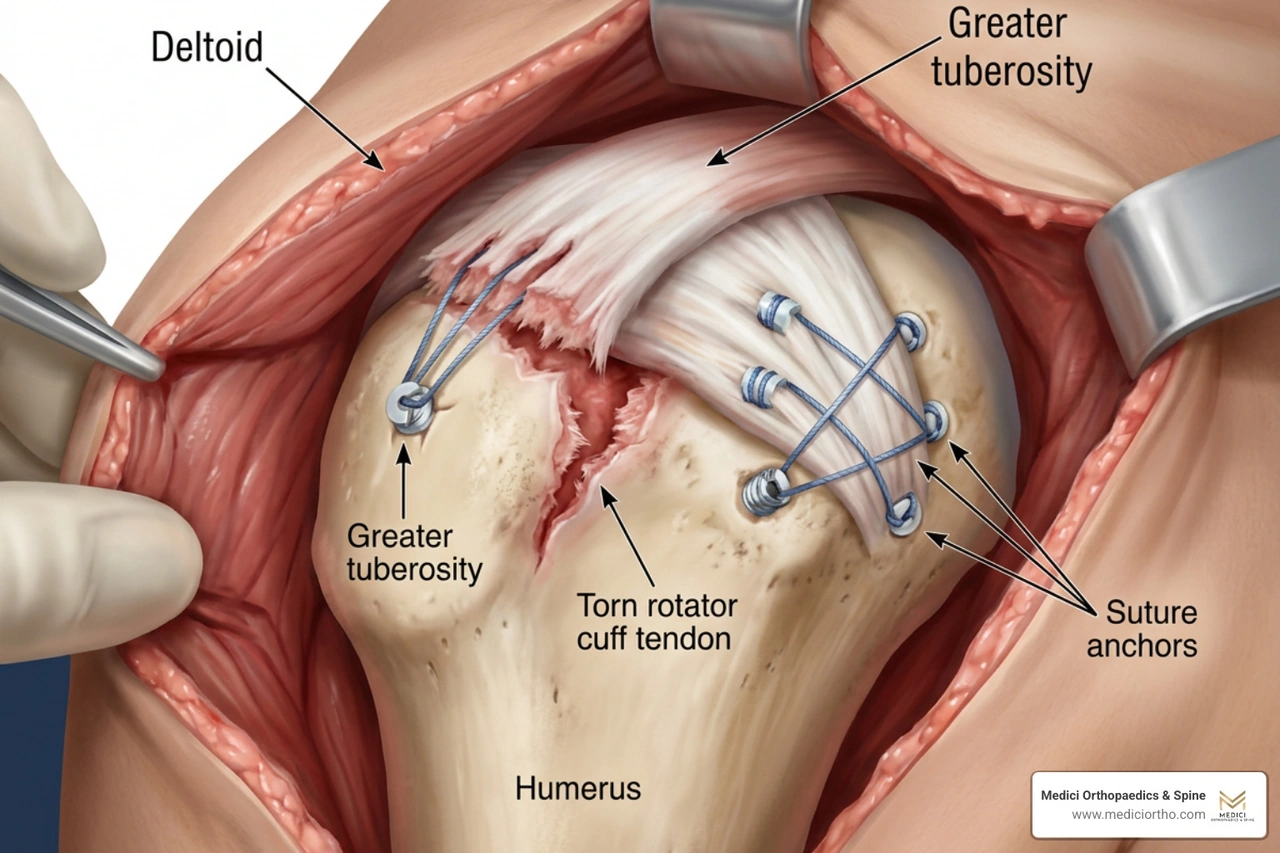
The anatomical footprint of the posterosuperior rotator cuff is surprisingly large, with a minimum medial-to-lateral width of about 14.7 mm. When we perform a traditional single-row repair, we place a single line of suture anchors along the outer edge of this footprint. Biomechanical data reveals that a single-row repair covers only 52.7% of the anatomical rotator cuff footprint. The remaining inner portion of the footprint is left exposed, meaning the tendon is not pressed against the bone where it naturally belongs.
In contrast, a double-row repair utilizes a medial row of anchors (closer to the joint surface) and a lateral row of anchors (further down the bone). This two-row architecture can restore up to 100% of the native footprint.
By pulling the tendon down across the entire width of the bone, we vastly increase the contact area and contact pressure between the tendon and the bone. A larger healing surface area means the body can form a broader, more robust bridge of fibrovascular scar tissue, which is critical for long-term recovery. This is explained in detail in this scientific analysis of single vs double-row biomechanics.
The shoulder is subject to immense physical forces, even during simple daily movements. The supraspinatus and infraspinatus tendons routinely experience physiological loads ranging from 175 N to over 900 N. If a surgical repair cannot withstand these forces, gap formation occurs — meaning the tendon pulls slightly away from the bone, preventing biological healing.
Biomechanical testing demonstrates that double-row constructs offer a 23% to 48% increase in ultimate load to failure compared to single-row repairs. Specifically:
This superior strength is achieved because the double-row layout distributes the mechanical tension across multiple points. It creates a self-reinforcing construct (often resembling a tension-band mechanism) that minimizes the stress concentrated on any single suture-tendon interface. For a deeper dive into these mechanical properties, you can explore this biomechanical review of double-row strategies.
As arthroscopic surgical technology has advanced, several variations of the double-row repair have emerged. Understanding these techniques helps us tailor the surgery to a patient’s specific tear pattern and tissue quality.
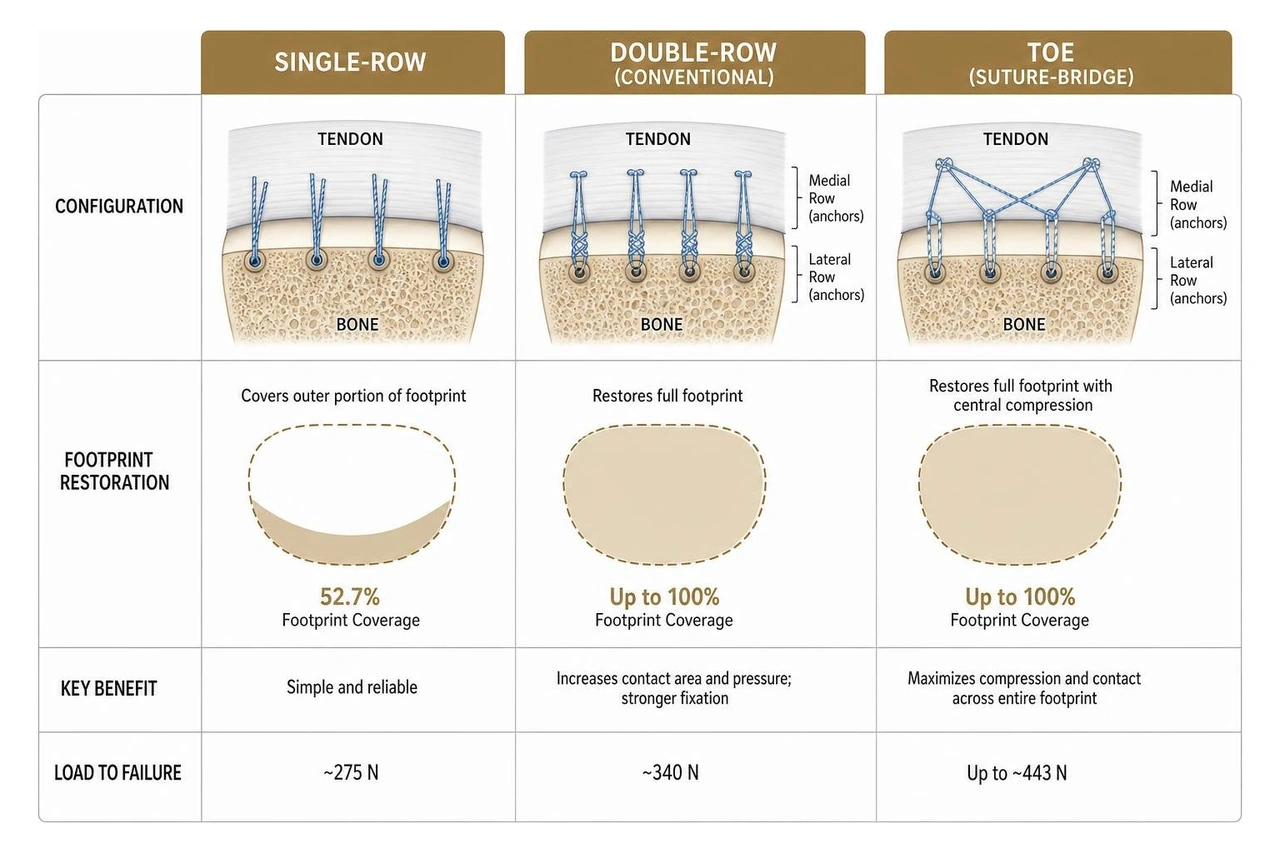
The conventional double-row repair involves placing independent anchors in both the medial and lateral rows, with knots tied over the tendon at each anchor site. While this secures the inner and outer borders of the tendon, it does not necessarily compress the tissue in the middle of the footprint.
To solve this, surgeons developed the Transosseous-Equivalent (TOE) or "suture-bridge" technique. In a TOE repair:
This suture-bridge design provides uniform, continuous downward compression across the entire footprint. Because the bridging sutures are interconnected, the construct becomes self-reinforcing under load. As the muscle pulls on the tendon, the cross-linked sutures actually tighten down further, locking the tendon against the bone and preventing gap formation.
Within the TOE framework, surgeons must choose between using knotted or knotless techniques on the medial row.
Traditional TOE repairs require tying knots over the medial row anchors before crossing the sutures to the lateral row. However, tying bulky knots can occasionally lead to subacromial impingement (where the knot rubs against the overlying bone) and can restrict blood flow to the healing tendon. In fact, clinical evaluations have shown up to a 44.67% reduction in local tendon blood flow after rigid, knotted TOE repairs due to tendon strangulation.
Knotless TOE techniques (such as the SpeedBridge design) eliminate the medial knots entirely. The sutures are passed through the tendon and directly tensioned and secured into the lateral anchors. This approach offers several clear benefits:
Innovative modifications continue to push these boundaries. For example, some surgeons utilize a "double-double row" technique, which adds extra anterior anchors in the bicipital groove to maximize compression on the robust leading edge of the supraspinatus. This variation is discussed in this study on double-double row repair.
While biomechanical superiority in a laboratory setting is impressive, the ultimate test is how these techniques perform in real patients. Does the increased complexity and cost of a rotator cuff tear double row repair translate to better healing and fewer failures?
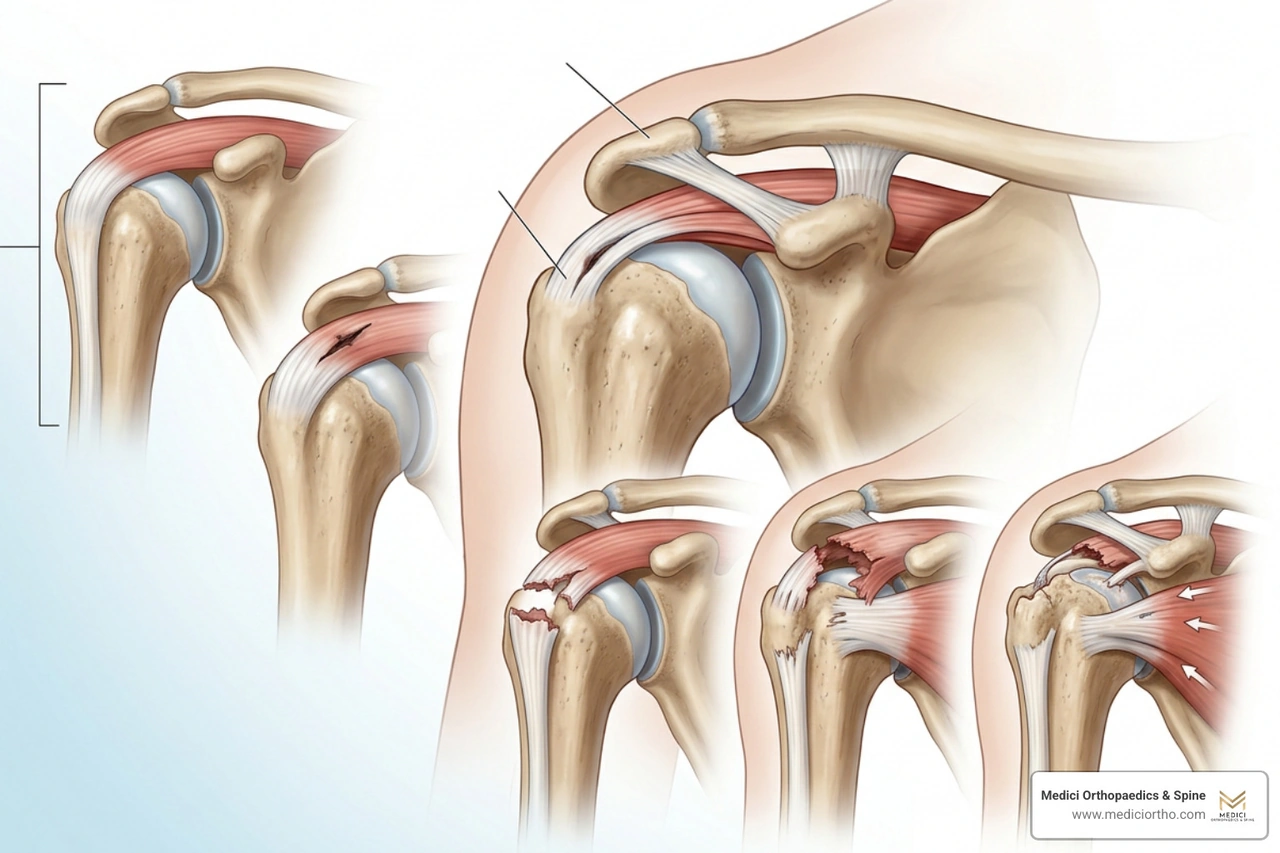
The answer depends heavily on the size of the tear. For small tears (under 3 cm), clinical trials often show that both single-row and double-row repairs yield excellent, comparable functional outcomes. However, as the tear size increases, the structural advantages of double-row and TOE repairs become undeniable.
The primary challenge in treating large to massive rotator cuff tears (greater than 3 cm) is the exceptionally high rate of structural failure. When a repaired tendon fails to heal, it typically retears along the suture line.
Let's look at what the clinical literature tells us about retear rates across different techniques:
These statistics, supported by a comprehensive meta-analysis of single-row vs double-row outcomes, demonstrate that double-row and TOE constructs provide a far safer environment for large tears to heal. To read more about how these techniques perform in massive tear scenarios where muscle quality is still preserved, see this retrospective cohort study on massive tear repairs.
Does a lower retear rate mean a happier patient with a better-functioning shoulder? Yes, especially over the long term.
While short-term clinical scores (like the ASES, Constant, and UCLA scores) can sometimes appear similar because both surgeries successfully relieve pain, long-term tracking reveals a clear divergence. At an average 99-month follow-up (over 8 years post-surgery), double-row repairs yielded good or excellent functional outcomes in 90% of massive rotator cuff tears, compared to only 70.9% for single-row repairs.
Furthermore, double-row repairs result in significantly better postoperative shoulder strength. Patients who undergo double-row or modified suture-bridge repairs achieve an average abduction strength ratio of 86.0% at 12 months, compared to 76.8% for single-row repairs. This extra strength can make a massive difference for active individuals, athletes, and those with physically demanding jobs in the Metro Atlanta area.
While the structural benefits of a double-row repair are clear, it is not a "one-size-fits-all" solution. The procedure is technically demanding, requires more surgical hardware, and is associated with specific clinical trade-offs.
Every surgical technique carries a unique complication profile. For single-row repairs, the classic mode of failure is "type I" — where the suture cuts through the edge of the tendon or the anchor pulls out of the bone.
For double-row and TOE repairs, we occasionally see "type II" failures, also known as medial row insufficiency. This occurs when the tendon tears directly at the medial row of anchors, leaving a stump of tissue still attached to the lateral bone. This is often caused by:
A double-row repair utilizes more suture anchors and high-strength tapes, which increases implant costs. It also requires a higher level of arthroscopic skill, which can slightly increase operative time in the theater.
Therefore, we must weigh these upfront costs against the long-term benefits. For a young, active patient or someone with a large tear (>3 cm), the double-row or TOE technique is highly cost-effective because it dramatically reduces the risk of a retear. Preventing a second "revision" surgery saves the healthcare system — and the patient — significant time, money, and physical distress.
Conversely, for an older, sedentary patient with a small tear and lower physical demands, a single-row repair or even conservative, non-surgical management may be the most appropriate and cost-effective choice. If you are wondering whether surgery is even necessary for your specific shoulder pain, you can read our detailed guide: Do I need surgery for a rotator cuff tear?.
Regardless of whether a single-row, double-row, or TOE technique is used, the biological timeline of tendon-to-bone healing cannot be rushed. It takes about 12 weeks for the tendon to firmly reattach to the bone.
At Medici Orthopaedics & Spine, we design highly customized, progressive physical therapy programs to protect the surgical repair while gradually restoring motion and strength. Here is what a typical recovery timeline looks like:
We offer comprehensive, hands-on physical therapy at our state-of-the-art facilities in Georgia. To learn more about our localized rehabilitation programs, you can read about Post-surgical rotator cuff PT in Marietta or find out What to expect from post-surgical physical therapy in Kennesaw.
Managing pain during this recovery period is also a top priority for our team. We specialize in cutting-edge, non-narcotic pain relief modalities to help you recover comfortably without relying on addictive medications. You can explore these options in our guide on Alternatives to opioids for post-surgical pain relief.
While initial tendon healing takes about 12 weeks, a full recovery typically takes 6 to 8 months. Most patients can return to light daily activities within 6 weeks, but overhead sports, heavy lifting, and strenuous labor require waiting until the muscles are fully strengthened and the repair is mature.
The primary advantage is superior structural healing. By restoring up to 100% of the tendon's natural footprint (compared to just 52.7% with a single-row), a double-row repair provides double the contact area, higher initial fixation strength, and a significantly lower risk of retearing — especially for tears larger than 3 cm.
Yes, provided the remaining tendon tissue is of sufficient quality and can be mobilized back to the bone without extreme tension. For massive tears, we often utilize a transosseous-equivalent (TOE) suture-bridge repair to maximize the chances of successful healing. However, if there is severe fatty muscle degeneration (Goutallier stage 3 or 4) or if the tendon is completely retracted and immobile, alternative options like superior capsular reconstruction (SCR) or regenerative graft augmentation may be considered.
When it comes to repairing a torn rotator cuff, the clinical and biomechanical evidence clearly shows that "two rows are indeed better than one" for medium, large, and massive tears. Techniques like the transosseous-equivalent (TOE) suture-bridge provide unmatched structural stability, maximizing your body's ability to heal and minimizing the risk of a frustrating retear.
However, surgery is a major milestone, and it is not always the first or only answer. At Medici Orthopaedics & Spine, led by Dr. Sonny Dosanjh, M.D., we believe in a patient-centered, integrated approach. We explore every possible avenue to restore your quality of life using the most effective, least invasive, and least drug-dependent programs available today.
Before committing to surgery, we highly recommend exploring our comprehensive Non-surgical treatment for rotator cuff injury options, which include advanced physical therapy, regenerative medicine, and targeted interventional injections.
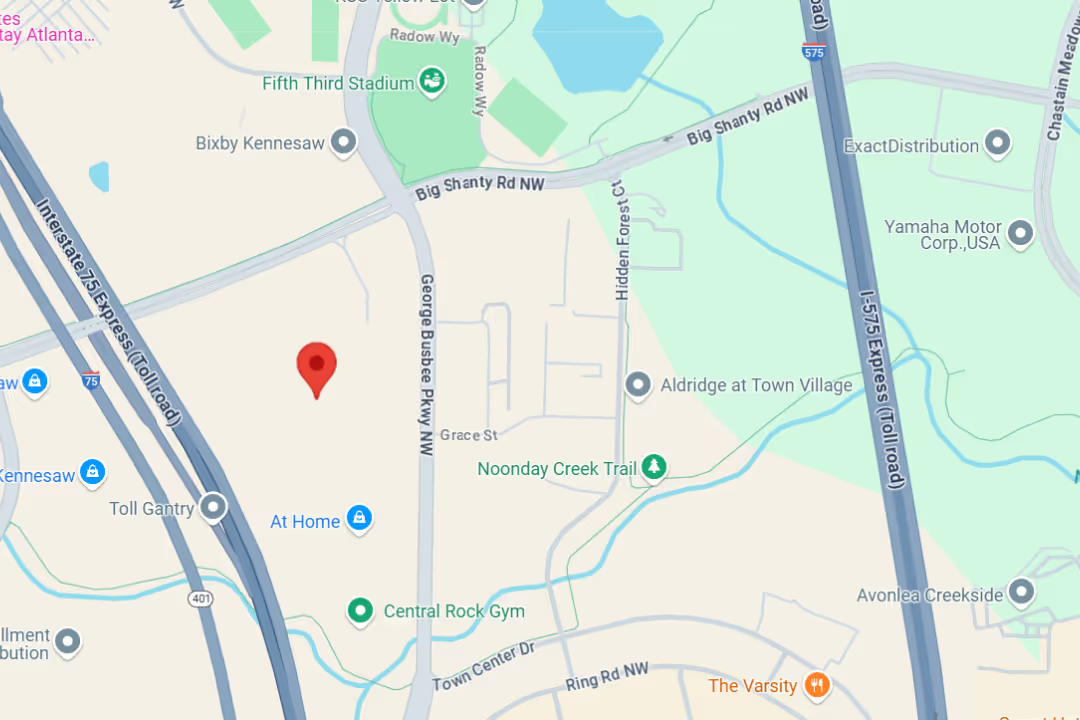
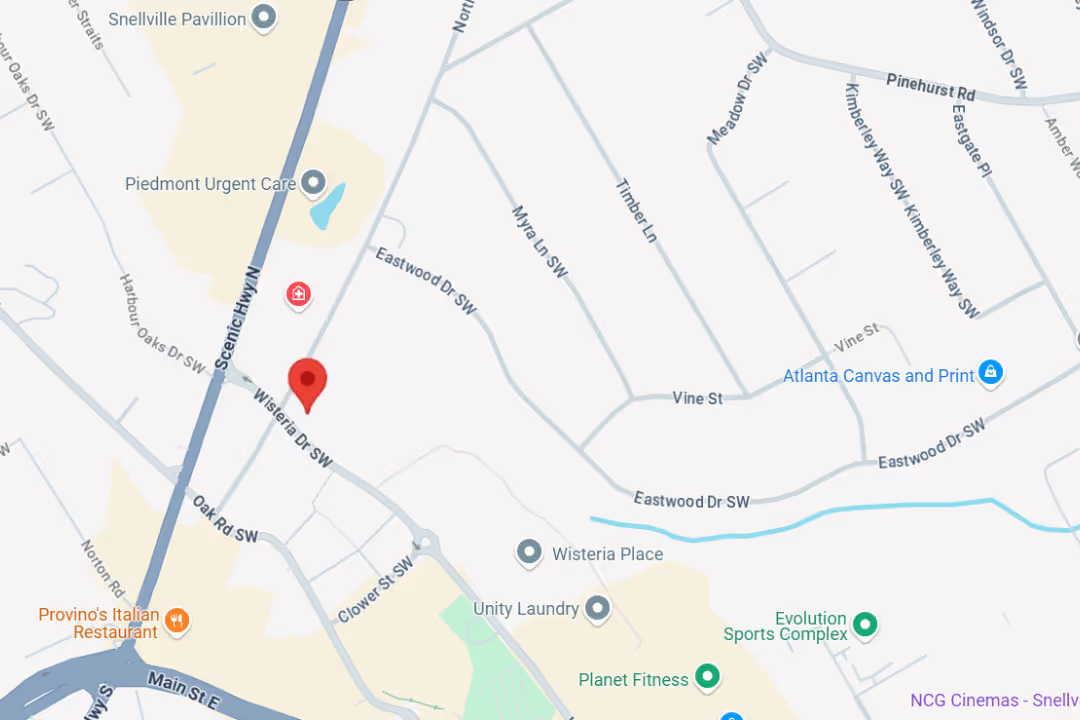
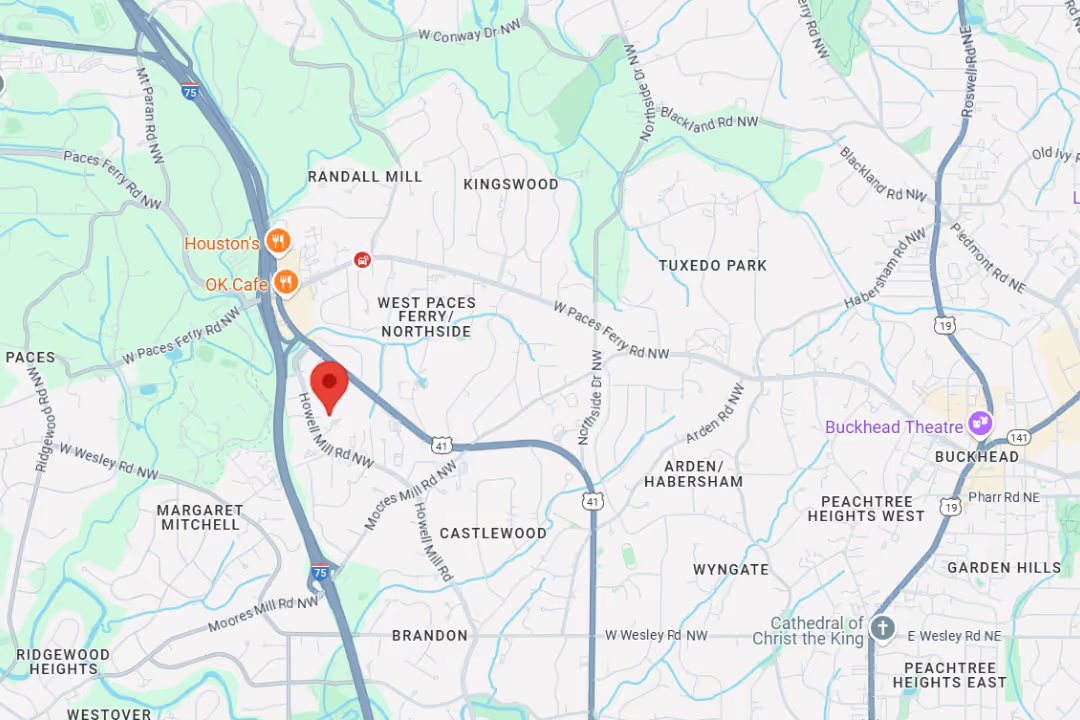
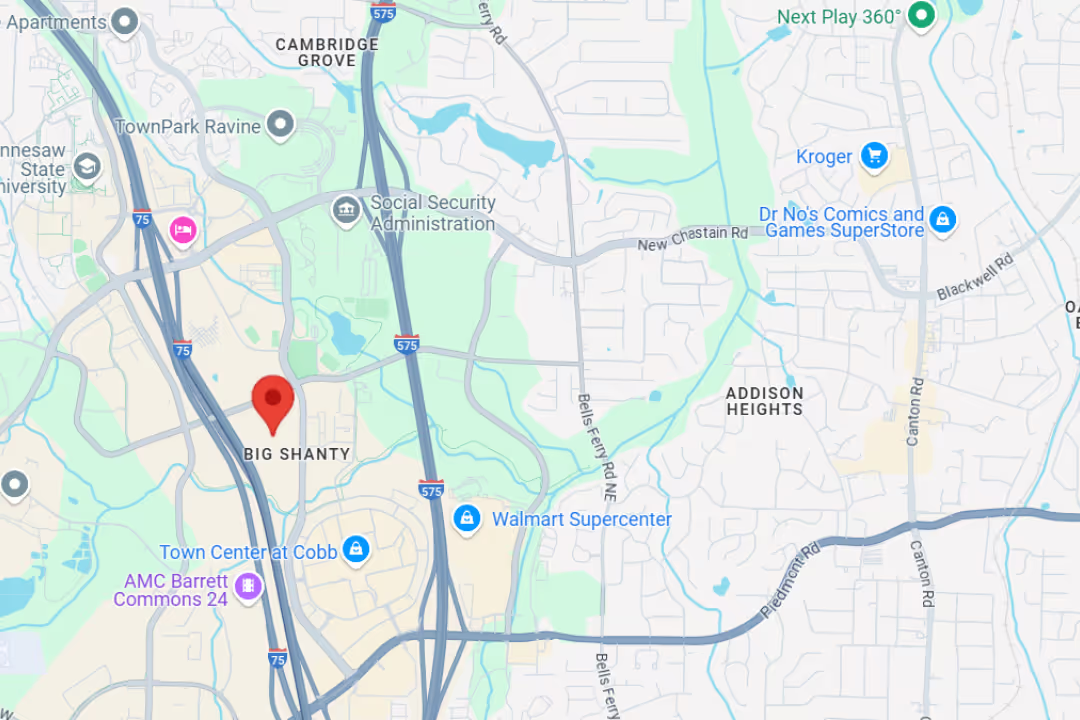
Whether you need a cutting-edge surgical repair or a customized conservative recovery plan, our team is here to support you at our convenient locations across Metro Atlanta, including Snellville, Marietta, Kennesaw, and Buckhead.
To schedule a comprehensive shoulder evaluation and find the right path forward for your active lifestyle, visit our website at Medici Orthopaedics & Spine.
At Medici, you’re more than your MRI.
We take time to hear your story, understand your pain, and create a plan that actually works for you.

Our team delivers specialist care at convenient locations across Metro Atlanta:
Get expert tips on injury recovery, pain relief, joint health, and movement strategies—straight from our Fellowship-Trained team.