De Quervain violinist pain is one of the most common — and most career-threatening — overuse injuries in string players, caused by inflammation of the tendon sheaths on the thumb side of the wrist.
Quick answer: What you need to know
Think about this: playing just one movement of Handel's Messiah requires a violinist to bow 740 times in under two minutes. Do that day after day, year after year, and it's not a question of if the tendons will protest — it's when.
Up to 75–89% of violinists experience some form of playing-related musculoskeletal pain during their careers. De Quervain's tenosynovitis is one of the most frequent culprits, affecting both the bowing arm and the fingering hand due to the relentless, repetitive demands of the instrument.
The frustrating part? Many violinists push through the pain, often making the injury significantly worse before seeking help.
I'm Dr. Sonny Dosanjh, M.D., founder of Medici Orthopaedics & Spine, board certified in Physical Medicine & Rehabilitation, and fellowship trained in Multidisciplinary Pain Management at Emory University — and I've helped countless patients, including musicians, overcome de Quervain violinist pain without defaulting to surgery or long-term medication. In this guide, I'll walk you through exactly how this injury develops, how to confirm it, and — most importantly — how to treat it so you can get back to playing.
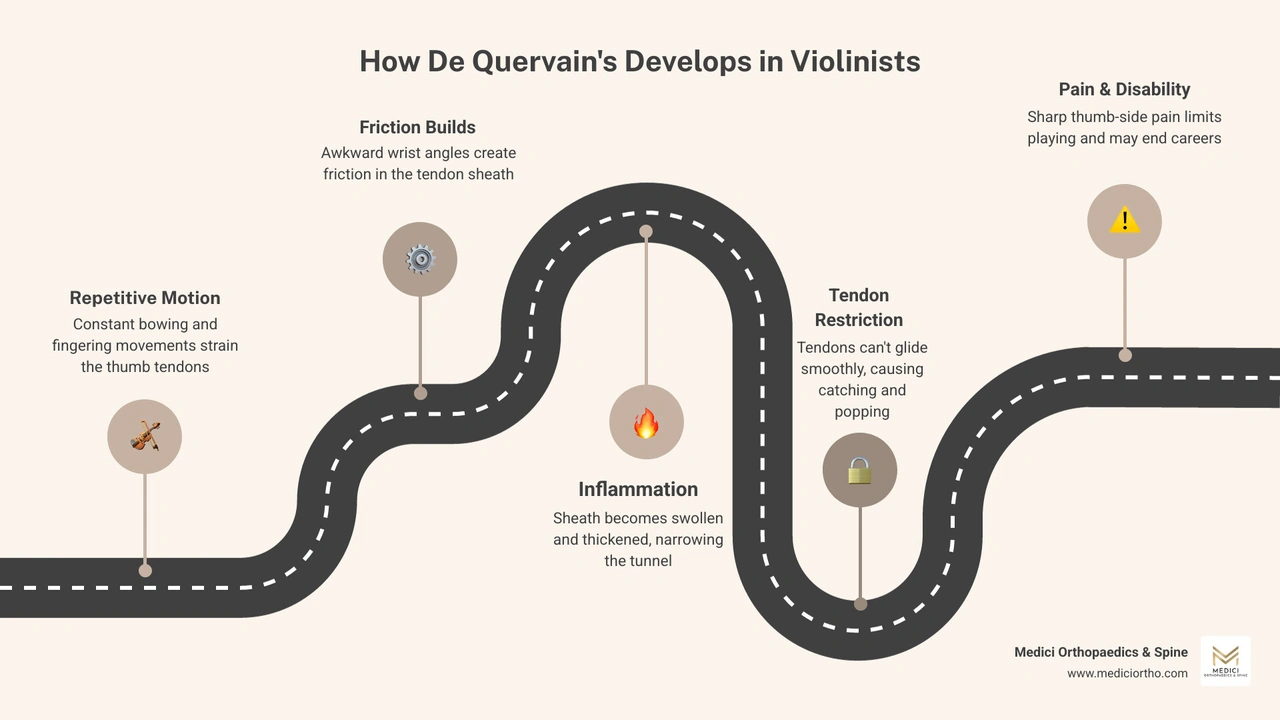
To understand why playing the violin is so biochemically taxing, we have to look at the anatomy of the wrist. On the thumb side of your wrist, two primary tendons run through a narrow, lubricated tunnel called the first extensor compartment. These are the abductor pollicis longus (APL) and the extensor pollicis brevis (EPB) tendons. Their primary job is to pull your thumb away from your hand and extend it.
Normally, these tendons glide smoothly within their protective tendon sheath. However, repetitive motion and awkward wrist angles create friction. If this friction continues, the sheath becomes inflamed, swollen, and thickened. This narrowing of the tunnel restricts tendon movement, resulting in the characteristic pain of De Quervain's tenosynovitis.
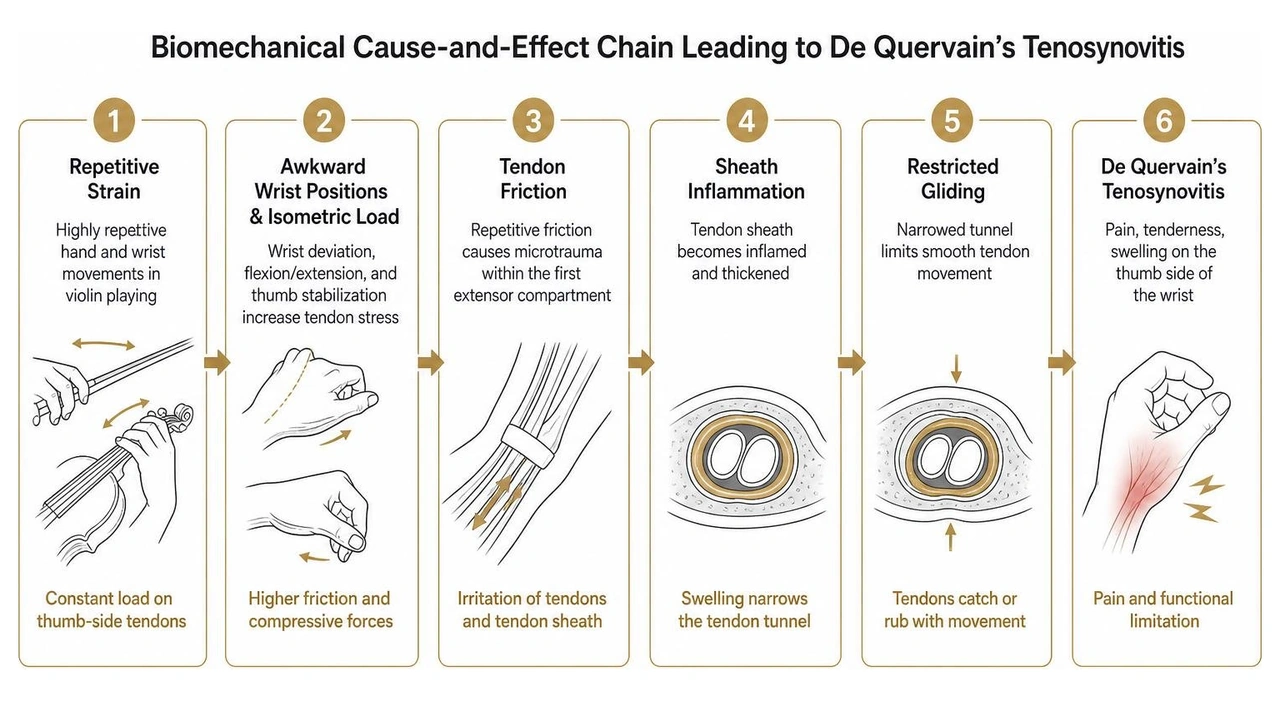
For violinists, both hands are subjected to unique, highly repetitive forces:
According to a review on the Epidemiology of Playing-Related Problems in Violinists, string players have the highest rate of playing-related musculoskeletal disorders of all instrumentalists.
A major contributing factor is muscle fatigue. When your stabilizing muscles tire during a long rehearsal, they lose their ability to act as shock absorbers. This shifts the dynamic load directly onto your tendons, causing microscopic tears. Furthermore, pressing down on the strings even 20% to 30% harder than necessary dramatically accelerates this cumulative micro-damage.
For a deeper dive into how this condition behaves mechanically, explore our de Quervain's Tenosynovitis condition page.
Recognizing the early warning signs of De Quervain's can mean the difference between a brief pause in your practice schedule and a multi-month forced hiatus.
The most common symptoms string players experience include:
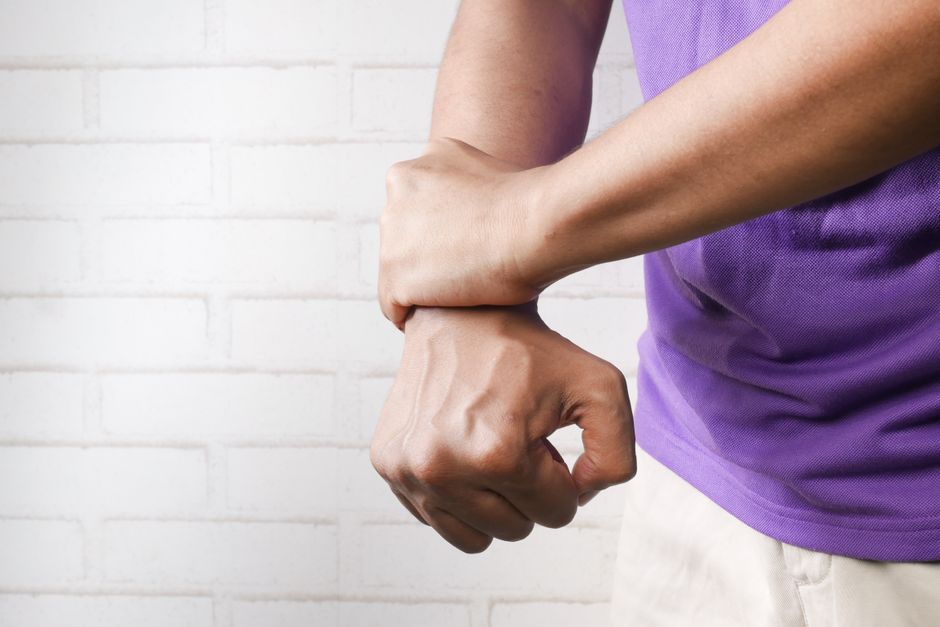
If you suspect you are developing De Quervain's, you can perform a simple, widely accepted diagnostic test at home called the Finkelstein maneuver.

To perform this test:
If this movement triggers a sharp, sudden pain along the thumb side of your wrist, it is a strong indication of De Quervain's tenosynovitis. While this test is an excellent screening tool, a comprehensive physical exam by a specialist is still essential to confirm the diagnosis and rule out other underlying issues.
Because the wrist is a complex structure containing eight bones, numerous ligaments, and multiple nerve pathways, it is easy to mistake De Quervain's for other common injuries.
String players frequently suffer from a variety of repetitive strain injuries, making accurate differentiation critical for effective treatment. For instance, carpal tunnel syndrome involves the compression of the median nerve, leading to numbness and tingling in the fingers, whereas De Quervain's is strictly a tendon-sheath issue characterized by mechanical pain.
Additionally, many musicians naturally possess joint hypermobility. Hypermobility syndrome (HMS) is present in roughly 35% of female musicians and 17% of male musicians, often causing chronic, unidentified wrist pain due to joint instability rather than isolated tendon inflammation.
De Quervain's Tenosynovitis
Carpal Tunnel Syndrome
Wrist Tendonitis
Hypermobility Syndrome
To learn more about how we evaluate and diagnose these complex hand issues, visit our Hand Wrist Pain and Injuries condition page.
At Medici Orthopaedics & Spine, our ultimate goal is to get you back to your music using the most effective, least invasive methods available. We believe in avoiding surgery whenever possible, as invasive procedures carry risks of scar tissue formation that can permanently alter a musician's fine motor control.
A highly detailed clinical review on Musicians' Medicine: Musculoskeletal Problems in String Players emphasizes that conservative, non-surgical therapies should always be the first line of defense.
Our integrative treatment programs combine several synergistic therapies to accelerate your recovery:
In the early stages of de Quervain violinist pain, simple, conservative interventions can yield remarkable results.
First and foremost is resting the hand. This does not necessarily mean stopping all musical activity immediately, but it does mean setting strict boundaries. We often recommend utilizing a thumb spica splint. This specialized brace immobilizes both the thumb and the wrist, allowing the inflamed tendon sheath to rest and heal during daily activities and sleep.
Additionally, targeted physical rehabilitation is vital. Once the acute inflammation has subsided, we introduce gentle eccentric exercises (strengthening the muscle while it lengthens) to rebuild the tendon's resilience. Myofascial release and deep tissue massage can also help break up soft tissue restrictions in the forearm, reducing the tension transmitted to the wrist.
For practical advice on managing this condition during everyday tasks, you might find our De Quervain Office Worker post helpful.
While the vast majority of violinists recover fully through non-surgical means, surgery may be considered in rare, severe cases where conservative therapies have failed to provide relief after several months.

The surgical procedure, known as a first extensor compartment release, is a quick, outpatient procedure performed under local anesthesia. During the procedure, a hand specialist makes a small incision over the thumb side of the wrist to locate the constricted tendon tunnel. The surgeon then carefully cuts the roof of the sheath, releasing the pressure and creating more room for the tendons to glide freely.
While the surgery itself is highly successful, the recovery phase requires extreme discipline for a professional string player.
When returning to the instrument, you must start incredibly slowly. Take a page from the book of legendary violinist Elizabeth Wallfisch, who, after recovering from a severe repetitive strain injury, restarted her playing at just 30 seconds a day, slowly scaling up over months to rebuild her endurance safely.
Preventing the recurrence of De Quervain's requires looking beyond the wrist itself to evaluate your entire physical relationship with the violin.
Unnatural physical tension is the primary driver of overuse injuries. To minimize strain on your wrists and hands, consider making the following ergonomic adjustments:
To read an inspiring, first-hand account of overcoming severe, career-threatening playing pain through lifestyle modifications and strength training, read about Violinist Elizabeth Wallfisch on how she overcame chronic RSI.
The prognosis is exceptionally positive. With early diagnosis and a dedicated, non-surgical treatment plan, the vast majority of violinists achieve a full recovery and return to their previous playing capacity. The key is avoiding the temptation to "play through the pain," which only converts a temporary inflammatory issue into chronic tendon degeneration.
Professional violinists often face intense career pressure, strict performance schedules, and the fear of lost income, which can tempt them to delay treatment or hide their symptoms. However, they also frequently have better access to specialized performing arts medicine.
Amateur players, on the other hand, may have more flexibility to rest but might lack awareness of proper instrument ergonomics. Regardless of your playing level, early intervention is the most critical factor in preventing a minor strain from becoming a chronic issue.
Absolutely. A poorly adjusted violin setup forces your body to make constant, unnatural physical compensations. Raising your chin rest or adjusting the angle of your shoulder rest can allow you to hold the instrument with a more neutral head and shoulder posture. This directly reduces the extreme forearm supination and wrist deviation required of your left hand, taking the pressure off your wrist tendons.
Your hands are your voice, your passion, and your livelihood. At Medici Orthopaedics & Spine, we understand the immense physical and emotional toll that playing-related pain takes on a musician.
Led by Dr. Sonny Dosanjh, M.D., our team across Metro Atlanta — including our clinics in Snellville, Kennesaw, Marietta, and Buckhead — is entirely committed to delivering advanced, non-surgical, and minimally invasive treatments tailored to your unique lifestyle. We don't believe in quick fixes that simply mask your symptoms; we work synergistically with physical therapy, regenerative medicine, and ergonomic training to restore your physical health and preserve your ability to make music.
If you are struggling with de Quervain violinist pain or any other hand and wrist discomfort, do not wait for the injury to progress. Visit our de Quervain's Tenosynovitis condition page to schedule a comprehensive evaluation. Let us help you optimally restore your quality of life so you can play pain-free for years to come.
At Medici, you’re more than your MRI.
We take time to hear your story, understand your pain, and create a plan that actually works for you.

Our team delivers specialist care at convenient locations across Metro Atlanta:
Get expert tips on injury recovery, pain relief, joint health, and movement strategies—straight from our Fellowship-Trained team.